Exhibition
Korea
1 Oct 2026-31 Jan 2027
The British Museum
London WC1B 3DG
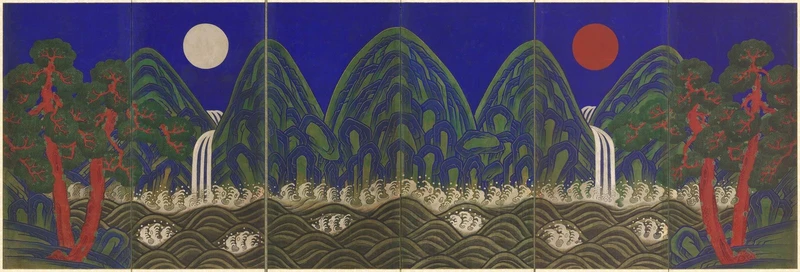
'Sun, Moon and Five Peaks' 6-panel folding-screen © National Museum of Korea
A new exhibition at the British Museum will explore over two millennia of Korean art and culture, offering a fresh perspective on the peninsula’s rich creative history. Drawing on exceptional works from the collection of the late Samsung Chairman, Lee Kun-Hee, this will be the first major exhibition on Korea’s art and history at the British Museum in over 40 years.
Spanning from 300 BC to the present day, Korea reveals how the country’s artists and craftspeople have continually demonstrated creativity, resilience, and superb technical skill, while absorbing outside influences to create a distinctive and enduring cultural identity.
At a time when Korean culture has an unprecedented global presence, often described as the Korean Wave, or hallyu, this exhibition offers important context for understanding its deeper historical roots. Since the 1990s, the Korean Wave has driven the global popularity of South Korea’s cultural economy, exporting music, film, television and wider pop culture worldwide. By placing Korea’s rich artistic heritage in a broader historical perspective, the exhibition reveals continuities and connections that extend far beyond the present moment.
The exhibition will trace Korea’s artistic and cultural history chronologically, bringing together seminal works, many designated National Treasures, on loan from the National Museum of Korea and the National Museum of Modern and Contemporary Art, alongside works from the British Museum. The objects on display are drawn from the recent donation of over 23,000 objects from Lee Kun-Hee’s collection to Korea’s national museums. This extraordinary gift has made possible a landmark exhibition that not only illuminates Korea’s artistic heritage but also reflects the longstanding dedication of one of its most important collectors.
The exhibition presents historic national treasures alongside modern and contemporary works, creating a dynamic conversation across time. From the technical mastery of Goryeo celadon, renowned for their luminous blue-green glaze and intricate inlay, to the restrained elegance of Joseon porcelain shaped by Confucian ideals, historic objects are recontextualised through their relationship with contemporary society. This approach reveals how artists across centuries have continually revisited and reinterpreted the past, sustaining a living tradition while pushing creative boundaries.
Among the highlights are bronze ritual implements dating to 300 –100 BC, and a 13th-century gourd-shaped celadon ewer, an exquisite example of Korea’s refinement in ceramic technology, alongside rare Buddhist paintings that embody both spiritual devotion and artistic sophistication. A masterpiece of landscape painting, Jeong Seon’s Clearing after the Rain on Mount Inwang evokes the restless spirit of Seoul’s Mount Inwang through rain-darkened ridgelines and drifting layers of mist. Unlike many of his contemporaries, who favoured idealised imaginary landscapes, Jeong Seon transformed Korean landscape painting by depicting a distinctly recognisable local landmark with emotional depth. The selection also includes a work by Nam June Paik, the visionary artist widely regarded as a pioneer of video art.
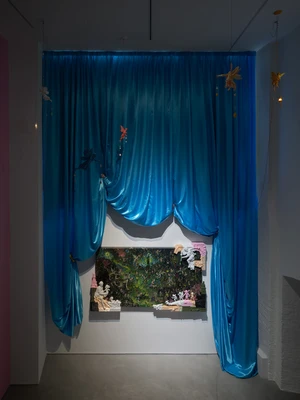
A new Museum acquisition by internationally acclaimed Do Ho Suh features as another key highlight, connecting themes of identity, migration and memory. Presented alongside historic objects, it underscores the exhibition’s central theme: the enduring dialogue between Korea’s past and present, and the ways in which cultural identity is continually redefined.
Korea is a story of progression and change, of adaptation and innovation. It offers a compelling insight into how creativity, technical skill, and cultural dynamism have defined Korean art and culture across time.