Overview
The Taraxacum Officinale is a fictional cultural event, an annual exhibition to be repeated every spring. It imagines a world where we try again and again to reverse our impact on the earth. For the title of this solo exhibition, Hilary Jack borrows and subverts the political and economic slogan “Growth, Growth, Growth!”. In doing so she questions a system in which economic expansion is prioritised over the well-being of nature, community and the Earth itself.
This year the Officinale re-imagines the depletion of Para rubber tree (Hevea brasiliensis) and looks to new inventions in dandelion cultivation as a way to alleviate deforestation and the slow regeneration, as the stock holders (some estimates show 71% are men with invested assets) snap at the heels.
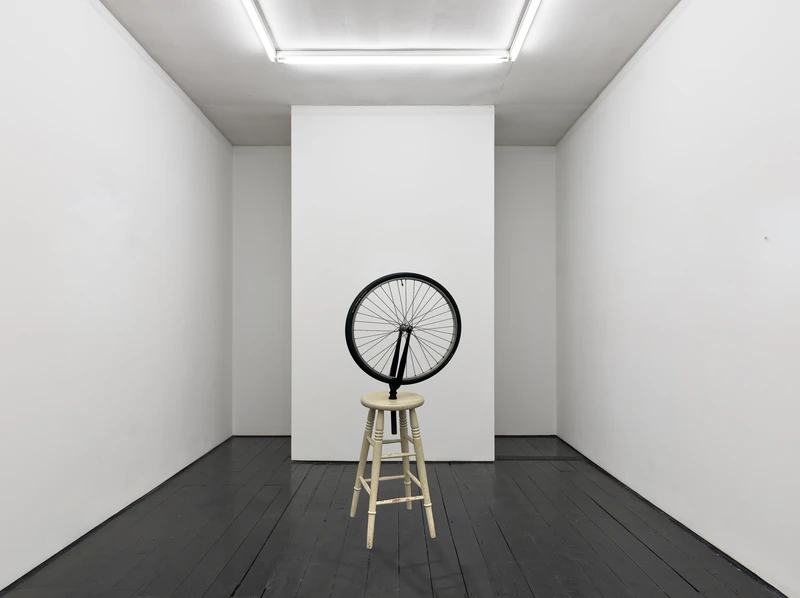
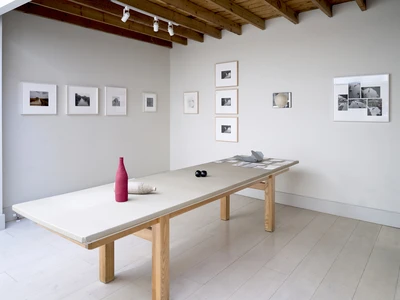
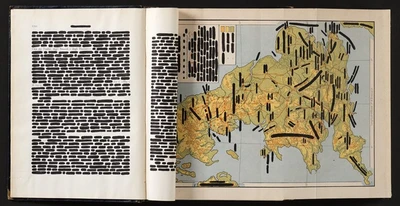
The work in this exhibition reflects on the relationships between everyday objects, the natural world, and the industrial extraction of natural resources. A chair made of wood reminds us it was once a tree; a Duchampian bicycle wheel, echoing Marcel Duchamp, mounted on a stool is reimagined as manufactured from dandelion serum; a series of collages juxtapose rural landscapes with scenes of industrial extraction, revealing how natural resources are removed and consumed, driving environmental degradation and social inequality, a contradiction often described as the “Paradox of Plenty”; a set of found and altered gardening tools point toward an alternative possibility of a future rooted in care, cultivation, and regeneration.
The Taraxacum Officinale, or the dandelion, is as much about commodity as it is about the fetish of rubber latex and conceptual art. Latex is understood here not simply as a material, but as a circulating form of capital*, historically extracted from Hevea brasiliensis and embedded within systems of ownership, speculation, and industrial power. The dandelion is repositioned within this logic as a speculative commodity, an abundant and overlooked plant recoded as future asset, demonstrating how capital continually seeks new ecologies to occupy, even under the guise of sustainability.
At the same time, rubber carries a libidinal charge, picture automobile tyre sales advertising, fresh black tyres, elasticity, sheen, and proximity to the road and the body situate it within a field of desire, fetishisation, and control. The material operates both industrially and erotically, revealing that commodity is never purely economic but also affective, bound to sensation, fantasy, and projection.
Through the lens of conceptual art, and in dialogue with Marcel Duchamp’s readymade, the dandelion becomes a gesture of designation rather than transformation. It is lifted, named, and reframed, hovering between weed and resource, artwork and commodity. Yet here the readymade is extended: it is not only an aesthetic operation but an economic one, exposing how value is assigned, circulated, and desired.
The Officinale ultimately stages a space where commodity, libidinal desire, and conceptual designation collapse into one another, questioning whether systems of extraction can truly be undone, or whether they are simply rearticulated, allowed to take root again in new, more palatable forms.