Overview
The Seven Deadly Sins (also known as the Capital Vices or Cardinal Sins) function as a grouping of major vices within the teachings of Christianity. The list which became formalized in the 6th Century by Pope Gregory I is Lust, Gluttony, Greed, Sloth, Wrath, Envy and Pride. These sins are often considered “deadly” because they are believed to be the root causes from which other sins and vices develop.
What is Sin? Used for over a thousand years, the current form of the word comes from Middle English sinne, derived from the Old English syn. The original meanings of sin were largely concerned with religious matters: “an offense against religious or moral law”; “a transgression of the law of God”(1) and are still used to this day.
Are these Sins still relevant? In 1993 Australian artist Susan Dorothea White created The Seven Deadly Sins of Modern Times, inspired by the Table of the Seven Deadly Sins, 1505-1510 by Hieronymus Bosch. This acrylic painting on a wooden table is where she proposes today’s deadly sins, the opposite of the original. Indifference replaces Anger, Self-effacement replaces Pride/Vanity, Celibacy replaces Lust, Workaholism in place of Sloth, Dieting replaces Gluttony, Squandering replaces Avarice/Greed and Sucking-up replaces Envy. White explains: “I reversed the tradition sins, replacing each with its antonym because the opposite extremes are just as ‘deadly’.”(2)
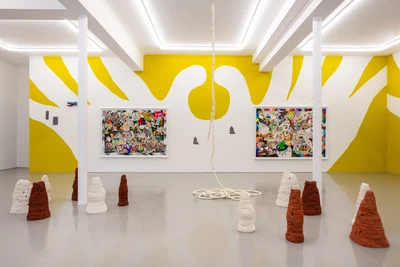
It seems that whether it is the original sins or a newer alternative, all are a commentary on the human condition – good or bad. This exhibition brings together Henrietta Armstrong, Nicola Bealing, Kate Lyddon, Joe Hesketh, Gillian Potkins, Rebecca Scott, Stella Whalley and Mark Woods, all who have used aspects of these sins within their practice.
Artist Statements
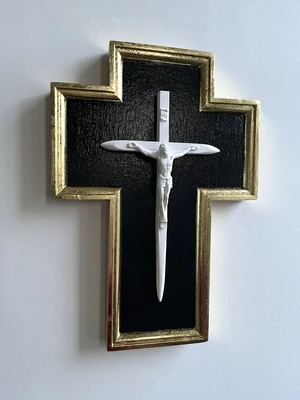
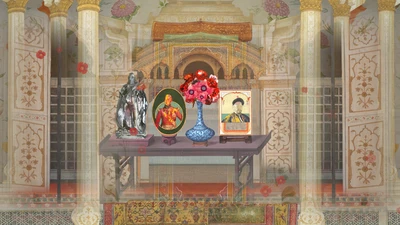
Henrietta Armstrong: PHARMAKON explores the paradoxical nature of sacred objects and their power. The crucifix is reconfigured as an instrument of defence, sanded to points like a stake occupies the space between salvation and violence. In Greek, pharmakon holds contradiction: both poison and cure. Derrida wrote that within every act of healing lies the potential to wound, a tension mirrored in faith, devotion and desire. Here, that ambiguity is transposed onto the Christian symbol of the innocent who is sacrificed for others and it becomes a relic of protection against what was once beloved or of betrayal. Its sharpened form carries a latent eroticism, the stake as both weapons and penetration, faith’s fervour entwined with desire. Gilded wood and black ground invoke the reliquary, preserving the trace of what has been cast out. In vampire myth, blood itself is a pharmakon, a contagious vitality, both life-giving and damning. Bloodletting replaces the ritual of expulsion, one life drained to sustain another.
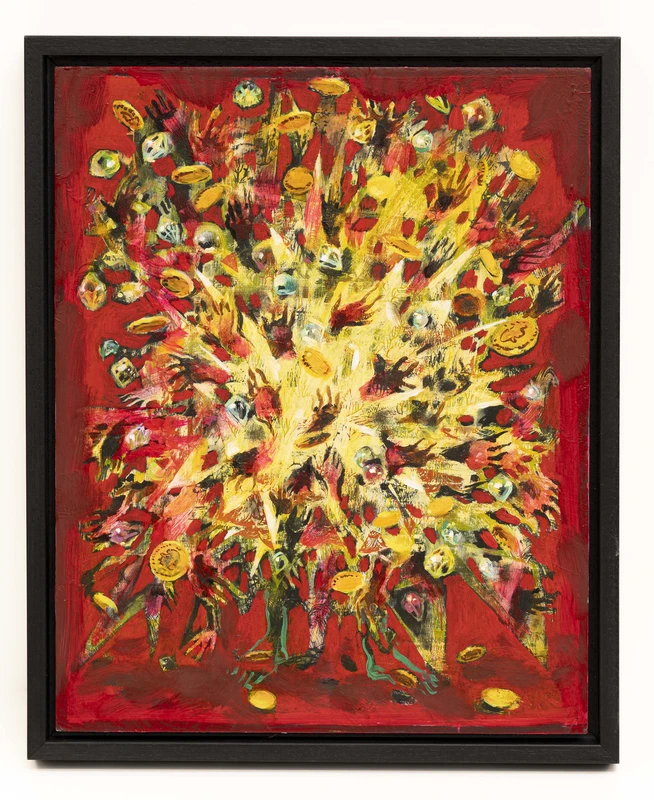
Nicola Bealing: One from a series of recent works on the theme of the Seven Deadly Sins. Greedy: the consuming individual has themself been consumed in a seething, explosive, self-combusting, grasping mass of furious GREED.
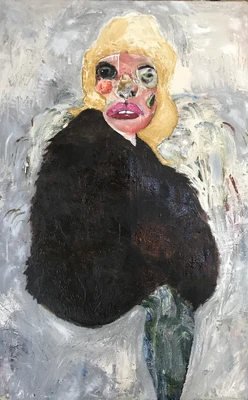
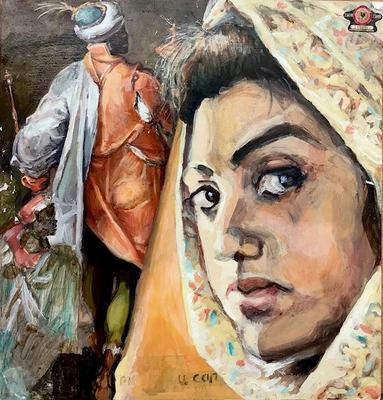
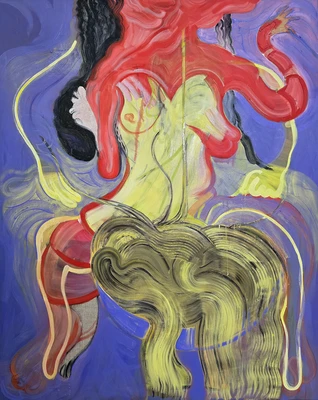
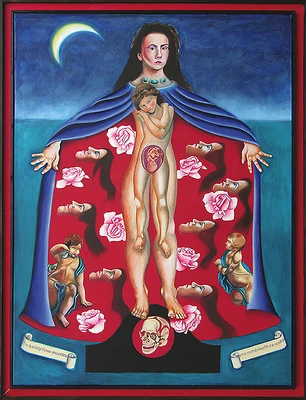
Kate Lyddon: My work has reflected on the stages of life from childhood to adolescence to womanhood in an exploration of the female experience, human dualities, cycles of life, and the subconscious. I’m interested in the idea of ‘slippage’, both visually through the medium of paint, and psychologically, as a way of describing the thought processes from which imagery arises. Visual slippages allow for a sense of in-betweenness, where images of youth and age, beauty and horror lapse in and out of focus through transparent layers of paint. The canvas becomes a threshold through which imagery forms in layers, leaving the viewer to find their own way through.
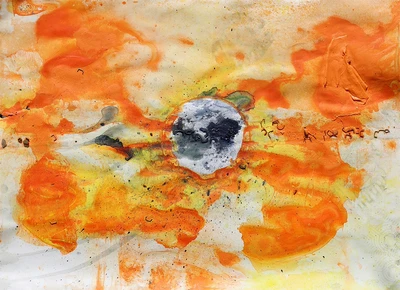
Joe Hesketh: My work in the show is about the human destructive bad behaviours, we steal, we cheat, an intelligent species, that’s so nasty, spiteful and self-destructive. Pivoting between sex, life, death, humour, tragedy and beauty that endures amidst the chaos of our world, saturated with a myriad of manmade horrors and injustices. Exploring a vivid depiction of the lawless territory that occupies the – often convoluted cynicism that seems to be inextricably bound to capturing the reality of what it means to be human.
Gillian Potkins: Pride and Wrath are from a series painted in the late 80s. I was playing with the literal meaning of the sins, their place in historical painting and their proximity to virtues. The warnings that were conjured up in their Christian foundation have become much more ambivalent in a secular society. In very many ways, capitalism revolves around the capital vices, especially so in this age of social media.
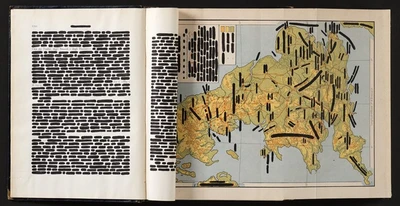
Rebecca Scott: This work derived from taking images found in Women’s fashion magazines, usually Vogue, then defacing each page. The first magazine I blocked out all the text, taking away such a large feature almost redesigns it, and it becomes more of a sketchbook. The second magazine I doodled and scribbled my way through the pages, a deliberate and spontaneous reaction to the formatted pages. From there I began redrawing the models I saw in the magazines, often reimagining the models as nudes, this action reminded me of the raw genital doodles you often find on graffitied walls; a puerile and mischievous action, often yielding interesting visual results. There is a juxtaposition and tension between the drawn image and the photographic, which I find visually challenging. My drawings with scribbles are spontaneous whereas the photographs are meticulously planned and created.
Stella Whalley: These fantastical Sinners are based on erotic surrealist writings and the environment, referencing a Hieronymus Bosch like ‘Garden of Earthly Delights’. Painterly fruits and flowers and printed Ginkgo leaves add to the dreamlike environment where the catlike figures hide. Some appear distorted with upside down bodies that seem to be woven or entangled within the foliage, they lick, wink and play out their drama. Using the viscosity of the paint and watery layers creating their own rhythms with the flick of colourful marks referencing what’s possibly garden settings without the botanical detail. They blend figurative and abstract elements creating a fluid interplay between the subjects and their imagined environments. This performativity invites viewers to question the authenticity and intent behind these images, prompting a deeper reflection on the nature of the gaze and the power dynamics it perpetuates.
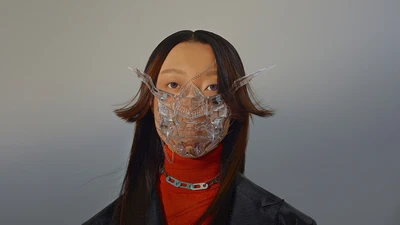
Mark Woods: Babydoll and Rose Garden Guard are a part of a series of photographs taken in private, dressing up in various guises/disguises. The reasoning behind this is an autobiographical exploration into his adolescence through to manhood, where it was impressed upon him that he had to follow the notions of masculinity and that there was no room or acceptance for femininity. In these images Woods dresses up, roleplaying characters where he is removing the gender norms and rebelling against his own masculinity. The only feature that stays the same is his face, keeping his identity but breaking through the barriers to challenge his personal, historic, and societal norms within the safe space of art.(3)
(1) https://www.merriam-webster.com/dictionary/sin
(2) https://www.susandwhite.com.au/enlarge.php?workID=86
(3) Taken from Mark Woods in conversation with Michael Petry, 15 April 2024, written in the essay How To Fashion A Man by Michael Petry written for Formula + Fetish by Mark Woods, published by Black Dog Press.