Exhibition
NS Harsha: Camel and the tent times
5 Jun-31 Jul 2026
Victoria Miro
London N1 7RW
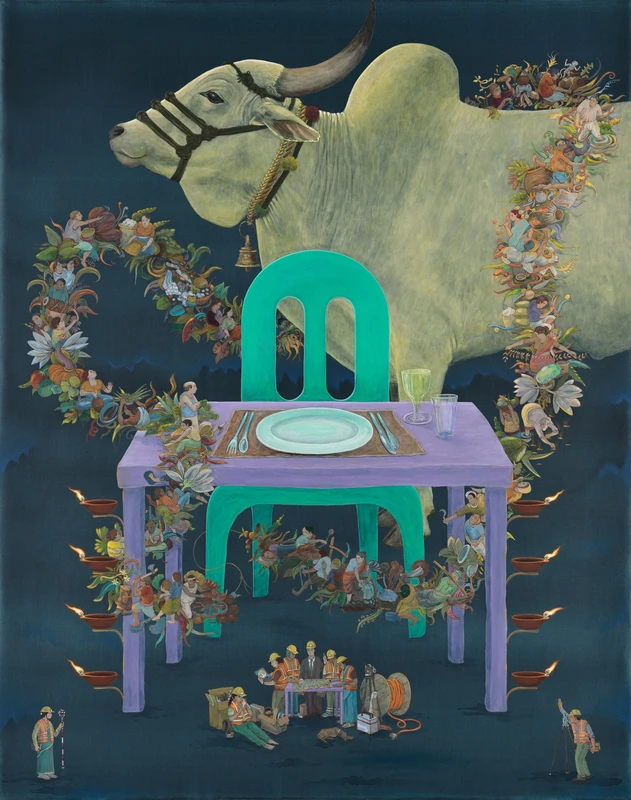
Victoria Miro is delighted to present new paintings by NS Harsha. The exhibition is accompanied by new writing on the artist by Grant Watson.
Camel and the tent times takes its title from a fable involving a merchant, his camel and the incursion of personal space. Writing about this tale in relation to NS Harsha’s paintings, curator and writer Grant Watson suggests, ‘The story seems to be a warning against the danger of accommodating others. It describes a world of limited resources… and can be seen as an allegory of our times… We understand that these paintings offer a reflection on the contemporary but from a very different perspective.’
For Watson, the difference in perspective stems from the notion of a breach; in Harsha’s work not a camel usurping its master’s place in the warmth, but something ‘disruptive, comic, inevitable, reversible’ challenging the established order. As Watson explains, the central ‘metaphor is of free play, the artist's dexterity and pleasure in shuffling the decks in an experimental form of visual thinking.’ We see this in paintings such as ‘That’ which dissolves labour, a scene depicting rows of workers enjoying a feast which is bisected by ‘a vortical line that runs through the centre, a tear in space-time revealing the cosmos…’; or in A zephyr over a collective dream with its ‘invisible wind that blows in from behind the canvas… guttering the rows of lamps, causing their flames to dip and dim but never go out.’
The works, which elaborate on the artist’s celebrated, ongoing ‘lamp grid’ series, feature diyas – lamps traditionally made from clay that are lit during rituals, prayers, ceremonies, celebrations and during power cuts – with flames and trails of smoke together creating patterns that guide the eye around each canvas: rising as a column (Workers having a break); ascending the legs of a table (Camel and the tent times); dancing shoal-like (Journey through water marks); or delineating a series of fluid brush strokes (Harvest as a water mark). In Harsha’s work they represent energy, forces perhaps unseen. As the emerging narratives pivot between aspects of work and rest, we become alerted to what is being planted or extracted, nourished or exploited – resources natural or human.
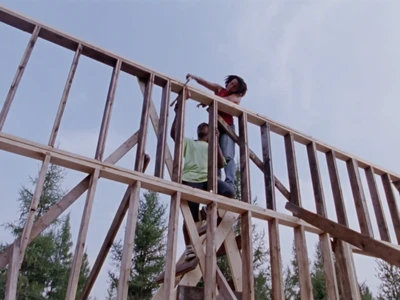
Workers having a break takes inspiration from the well-known 1932 photograph Lunch atop a Skyscraper, depicting ironworkers sitting on a beam of the RCA Building during the construction of the Rockefeller Center in Manhattan. Harsha’s diverse workforce takes its break held aloft by trails from a central column of lamps that extend into a nocturnal sky, suggesting a more mysterious interlude or escape into the nightly realm of dreams. The composition is echoed in the fiery A chandelier of our time, which the artist describes as ‘a chandelier studded with eternal human labour’.
Workers in ostensibly rural settings, such as in Harvest as a water mark, inspired by a visit to a paddy field, find themselves in the company of suited middlemen counting money, or birds feeding on insects and cows grazing, indicative of other ecosystems. This theme is picked up in Again, and again, and again where stooped rice field workers and ascending flames are counterpoints in a composition of rhythmic insistence. The title, as suggested by Watson, ‘might also refer to the quality of tenacity on display. How people throughout history have persevered. In spite of an inauspicious cosmic alignment, in the face of fire, famine, flood and war, always reconstructing, like ants whose nest has been poked with a stick. Demonstrating the centrality of human labour throughout history.’
NS Harsha: Camel and the tent times press release
Download