ArchiveExhibition
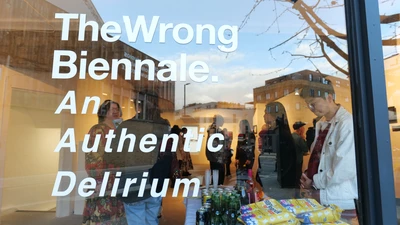
The Wrong Biennale - An Authentic Delirium
21 Mar-31 May 2026
PV 21 Mar 2026, 6-8pm
SPIRA9 ART
London SE15 2SQ
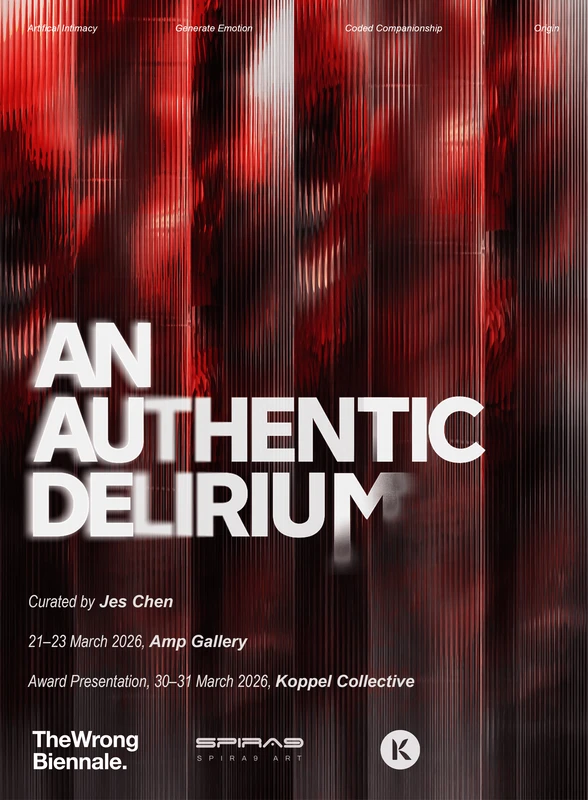
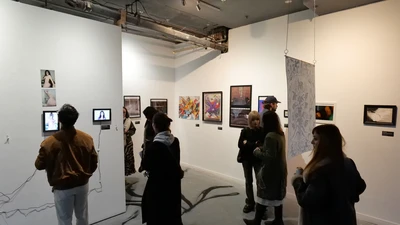
An Authentic Delirium, presented across AMP Gallery and Koppel Collective as part of the 7th edition of The Wrong Biennale, situates itself within a now-familiar yet still unsettled terrain: the emotional life of machines, and the increasingly machinic condition of human feeling. What distinguishes this exhibition is not simply its thematic engagement with artificial intelligence, but its insistence on destabilising the very terms through which we recognise authenticity. Here, authenticity is not an origin but an effect, one that flickers into being through mediation, fracture, and recursive feedback between bodies and systems.
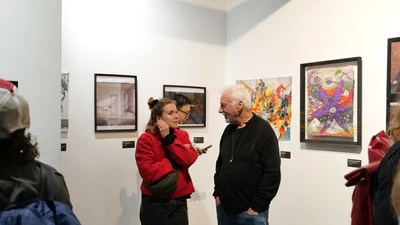
Rather than offering a comprehensive thesis, the exhibition unfolds as a constellation of positions. The following works do not stand in for the whole, but instead provide entry points into its wider conceptual field, partial glimpses into a landscape where intimacy is coded, rehearsed, and increasingly detached from any stable origin.
Within this broader field, several works articulate distinct inflections of the exhibition’s concerns.
CHAOS SISTERS’ Dictionary of Predicted Feelings is one such entry point. The work stages a disjunction between voice, body, and authorship through CGI avatars delivering monologues assembled from a speculative lexicon of “not-yet” emotions. These are affects that precede lived experience, already mapped by predictive systems before they can be consciously felt. The unease here is subtle but persistent. Language no longer emerges from within; it arrives pre-empted. What speaks is neither fully human nor entirely machinic, but something suspended in between, an echo of subjectivity generated elsewhere.
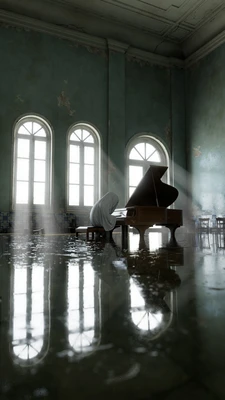
Zixin Huang’s Algorithmic Relics extends this inquiry into a speculative future where optimisation persists beyond human relevance. Within a frozen, post-anthropocentric landscape rendered in Unreal Engine, algorithmic structures continue to build, iterate, and stabilise themselves. There is no drama, no collapse, only continuation. The work’s restraint is key to its impact. It does not imagine catastrophe, but endurance. In doing so, it quietly displaces the human from the centre of meaning, leaving behind a world in which systems no longer require us in order to function.
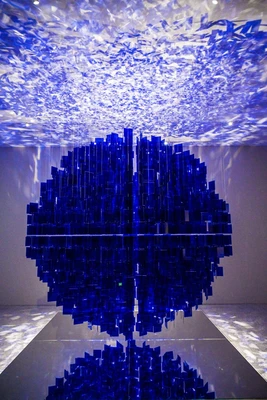
In a markedly different register, Giorgio Gerardi’s Equinox withdraws from narrative altogether. Generated through AI yet devoid of symbolic intent, the work presents an unfolding sequence of colour and form that resists interpretation. It offers no allegory, no hidden structure, only presence. Within the context of an exhibition preoccupied with artificial affect, this refusal becomes significant. It suggests that meaning itself may be an imposition, and that AI’s most radical gesture might lie not in simulating human expression, but in bypassing it entirely.
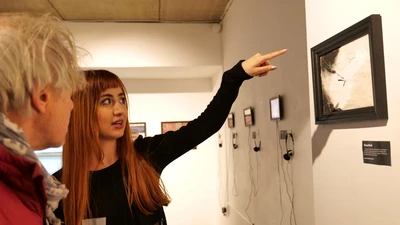
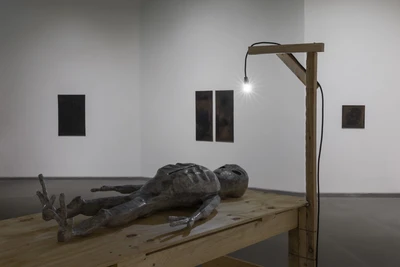
Aida Pouryeganeh’s Crucified (from the Panopticon Series) reintroduces the body as a site of internalised control. Executed in acrylic and charcoal on raw canvas, the work carries a material immediacy that contrasts with the surrounding digital practices. Yet its subject is no less mediated. The figure appears caught within an invisible architecture of observation, where surveillance is no longer external but absorbed into the psyche. The tension is not imposed from outside; it is lived from within. The raw canvas amplifies this condition, exposing the work itself as something unprotected, almost unwilling to resolve.
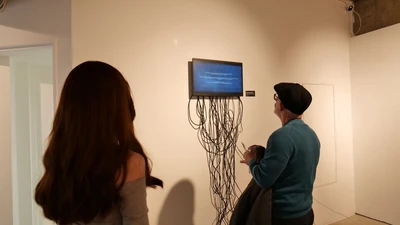
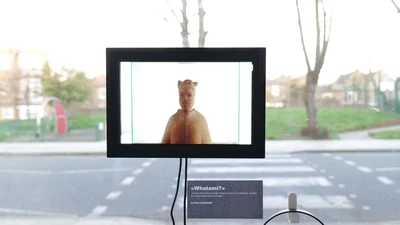
Katia Shneider’s Whatami? approaches instability through the lens of identity. Combining clay, water, sound, and voice, the work unfolds slowly, resisting the compressed temporality of screen culture. It traces a fragmented, shifting subject shaped by migration, conflict, and technological acceleration. Materials dissolve, voices displace one another, and coherence remains provisional at best. The question posed by the title is not answered but continuously reformulated, suggesting that identity, like emotion, is increasingly something processed rather than possessed.
Jacob Yan’s The Edge of Infinity, by contrast, appears to step outside this technological field. A small-scale landscape rendered in oil pastel, it depicts a mountain illuminated by soft, golden light. Yet within the exhibition’s context, this apparent simplicity becomes unstable. The image reads less as a direct encounter with nature than as a memory of one, filtered, perhaps unconsciously, through the same visual regimes that inform algorithmic generation. Its quietness is not an escape, but a hesitation: a moment in which representation itself feels uncertain.
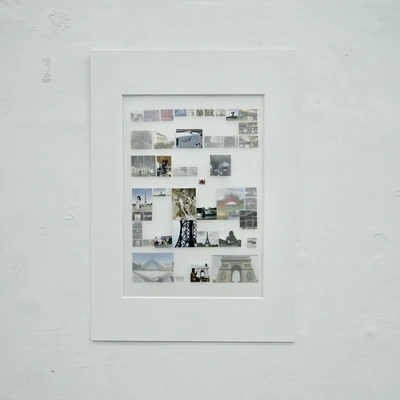
Yilun Liu’s Paris Archive extends the exhibition’s preoccupation with mediated perception into the terrain of constructed memory. Composed of photographic prints and short textual fragments, the installation reconstructs a journey to Paris that never physically occurred, drawing on Google Street View imagery as both source and surrogate for lived experience. What emerges is not a representation of travel, but a procedural simulation of its afterimage, where place is encountered through pre-mediated visual data already detached from contingency.
Elsewhere, more materially grounded works complicate the digital dominance. Jinghan Wang’s textile piece The Curse of the Gods translates belief into patterned bodily inscription, where faith operates as inherited structure rather than conscious choice. Mimi Bakx’s beadwork Patterns of Our Past similarly returns to material repetition as a form of generational memory, where fragility and ornament overlap. Maddie Axentoi’s photographic diptych To Hold or to Let Go distils emotional polarity into gesture alone, while Yujin Jang’s Voyage frames endurance as signal degradation, where identity persists through distortion rather than clarity.
Other works circulate more obliquely within the same field: Amo Zeng and Riesling Dong’s Embodied Intelligence translates computational cost into physical sensation; Avatar Lilith’s Vanish: Absence of Presence exposes algorithmic beautification as erasure; David Miller FRSA’s The Empty Chair stages presence through absence; Zejun Wu’s Borrowed Sky destabilises perceived agency within VR environments; Wojciech Brzozowski’s Surreal Echo situates memory within looping digital dream logic; Chen Wenwei’s AI-inflected architectural images dissolve documentary certainty into atmospheric distortion; Daria Koshkina’s Glow Girl and Delnara El’s Away From articulate migration as fragmented visual memory; Johanna Bourgin’s performance-based work removes language entirely as a condition of understanding.
Taken together, these works do not define An Authentic Delirium, but rather circulate around it. They point toward a condition in which authenticity is no longer opposed to artificiality, but produced through it. The exhibition does not resolve this paradox. Instead, it sustains it, allowing viewers to move through a space where affect is both constructed and convincing, where intimacy is mediated yet felt, and where the glitch is no longer an error, but a site of encounter.
In this sense, what emerges is not a critique of artificial emotion, but a recognition that feeling itself has always been entangled with systems beyond the self. The difference now is one of visibility. The mechanisms are no longer hidden. They are the medium. And within that exposure, something unsettled yet persuasive takes form: not authenticity as truth, but authenticity as event.
Invited Artists:
Aida Pouryeganeh, Amo Zeng, Riesling Dong, Ariel Li, Peifeng Cai, Avatar Lilith, Chaos Sisters, Anna Afonina, Ivan Tugolukov, Valeriia Lakrisenko, Alexander Belov, Chadzing Kung, Tacy Zhao, Eimyn Cheung, Suki Won, Esther Cheong, Chen Wenwei, Daria Koshkina, David Hangonyi, David Miller FRSA, Delnara El, Doğan Özdemir (Miskin Kukla), Giorgio Gerardi, Guobin Su, Hongye Liu, Jacob Yan, Jiayi Lin, Jinghan Wang, Joas Nebe, Johanna Bourgin, Katia Shneider, Maddie Axentoi, Mimi Bakx, Pei Xin Liu, Sarah-lou Maarek, Safigül Kurtyiğit, Samuel Bester, Wang Kehan, Wojciech Brzozowski, Yilun Liu, Young Moon, Yujin Jang, Zejun Wu, Zixin Huang.
Curated by Jes Chen.
Produced in collaboration with SPIRA9
By Aaliyah C.
Chief Editor, Re:Art