Overview
Genre [Manchine] Painting
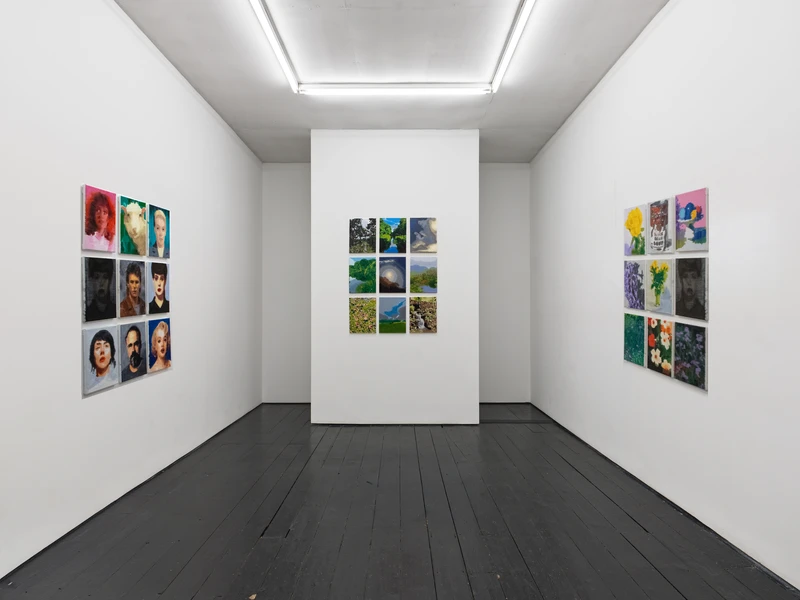
Genre [Manchine] Painting brings together a collection of recent works by Andee Collard that treat genre not as a fixed artistic category, but as a system repeatable, adaptable and open to manipulation. Using machine painting processes, the exhibition explores how familiar visual languages are constructed, reproduced and subtly broken. Motifs slide between the organic and the mechanical; gestures are repeated, misaligned and recoded. What emerges is a body of work that tests the boundaries between originality and iteration, authorship and automation, intuition and rule-based making.
Collard's paintings are produced by a custom built machine that translates code, image analysis and engineered movement into physical oil on canvas. Although the works are made by a machine, they are not powered by artificial intelligence. Instead, the system operates through written code and calibrated mechanics, closer to an automated drawing instrument than a learning algorithm.
Collard’s apparatus is intentionally limited, even slightly antiquated in its technological language. The system does not aspire to contemporary notions of intelligent automation. Instead, its mechanical logic foregrounds the translation from image to code, code to movement and movement to paint. Portraits, landscapes and still life genres historically rooted in human observation, become categories for a machine to process:
a face rendered as coordinates,
a landscape reduced to geometry,
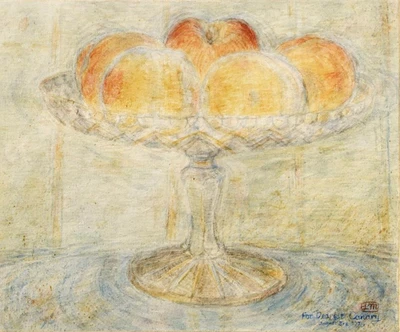
a still life translated into repeatable gestures.
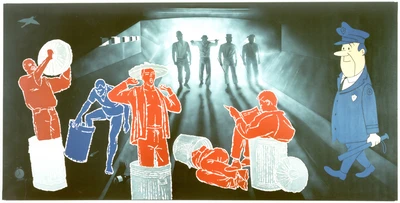
Within the framework of the gallery programme Division of Labour, the machine performs the act of painting with relentless repetition, following scripts written elsewhere, its gestures preordained. Here, the mechanical becomes a labouring body: a compliant worker whose productivity is continuous, whose understanding is unnecessary, whose purpose is the execution of a task divorced from reflection or intention.
There is something quietly spectral in this dynamic, resonating with longer histories of alienated labour, where the act of making is split from desire, ownership, and meaning. The machine paints without authorial subjectivity; the images it produces are not possessions but byproducts. Hovering between tool, worker, and servant. Within this uncanny economy, Collard’s paintings confront the question of artistic agency: what does it mean to make an image when the labour of its making has been ceded to a machine? The work exposes the ghostly contours of labour under late capitalism.