Overview
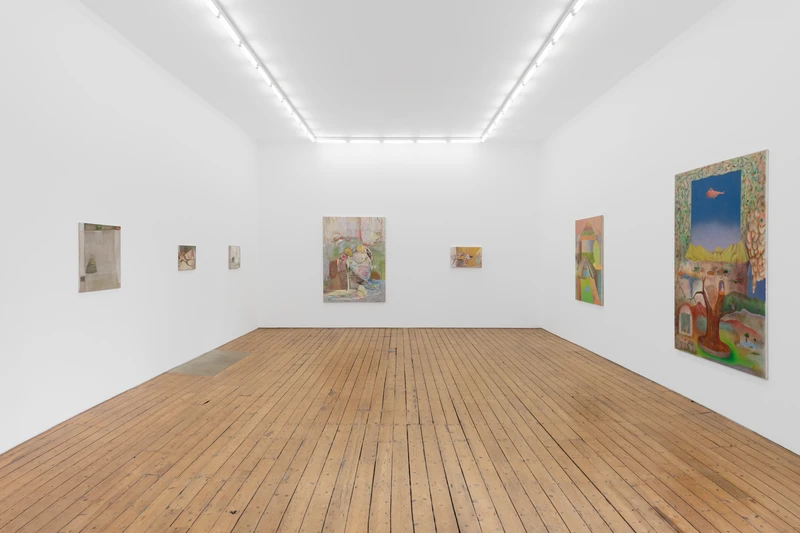
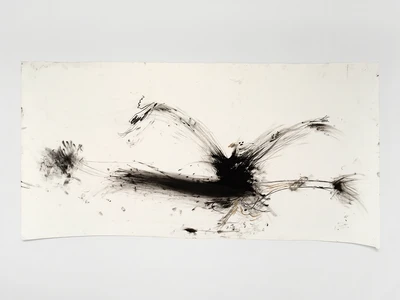
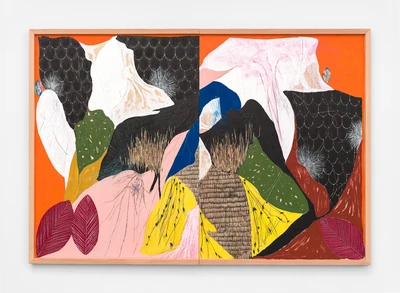
Thinking of somewhere else brings together Milton Avery, Gabriella Boyd, Anna Glantz, Merlin James and Stephen McKenna; five artists from different generations who attempt to translate our sensory experience of the world into painting. Positioned between abstraction and figuration, the works in the show articulate form through fields of colour, spatial relationships and tonal variations. The works are suggestive of architecture or landscape, yet remain undefined and ambiguous. Painting is approached not as a mode of pure representation, but as a means of revealing connections between vision, memory and language.
Milton Avery was an influential American modernist known for his simplified forms and bold use of colour. Born to a working-class family in Connecticut, he didn’t devote himself full-time to art until his move to New York in the 1920s at the age of 40, where his distinctive approach to colour and form later influenced a younger generation of painters including Mark Rothko and Barnett Newman. In his late painting Dark Fir (1962), Avery typically reduces the landscape to broad, flat planes and strong, simple form, creating a sense of calm and abstraction. The surface texture is notably grainy, with a subtle frottage effect that gives the work a less flattened, more tactile presence. The painting captures a contemplative childlike atmosphere, emphasising colour and composition over realistic detail, reflecting Avery’s mature style just two years before his death.
Gabriella Boyd’s dream-like compositions blend figuration with abstraction, with figures sometimes cropped, obscured, or interacting with abstract shapes, conveying emotion and psychological tension without relying on literal realism. In Gleaners and Mast (both 2026) her preference for warm, earthy tones is revealed, soft blues, greys, ochres, and dusty pinks are layered with gestural brushstrokes and semi-transparent glazes to produce textured and tactile surfaces. She works with light to add depth and movement to her paintings. Recurring motifs such as partial faces, isolated limbs and interior spaces evoke sensations of vulnerability, intimacy and the ephemeral nature of human interaction.
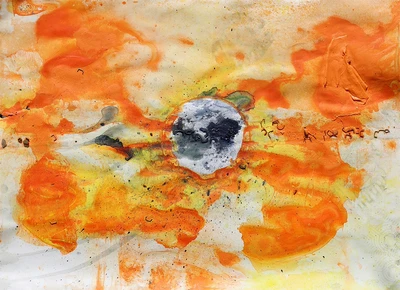
Anna Glantz has increasingly distanced herself from the conventions of figuration, evolving towards a more elusive and formally driven mode of painting. Deeply attentive to the quality of the painted surface, her compositions are densely built up and characterised by landscape-like formats in which horizon lines wobble and familiar imagery recedes, making way for a focus on structure, materiality and surface. In her works (all Untitled, 2025), representational cues have loosened, narratives are de-emphasised, and the depicted forms feel increasingly mysterious, prompting the viewer to consider the painting as an object in its own right. In her pursuit of a space that is unknowable yet undeniable, Glantz’s work evokes a haunting ambiguity, exploring how meaning emerges - or dissolves - on the canvas.
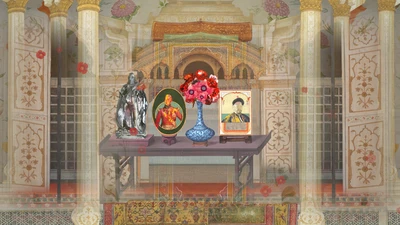
Merlin James approaches painting with a considered and unconventional perspective. His typically small-scale works, including Untitled (2013) and Royal Pavilion (2005-6), explore a wide range of subjects, from everyday architecture and riverside landscapes to post- industrial scenes, empty interiors, and intimate moments. Much of his work investigates new approaches to traditional concerns of narrative, pictorial space, expressive gesture, and the evocative power of colour and texture. James frequently references both classical techniques and contemporary ideas, creating a meaningful dialogue between past and present artistic practices.
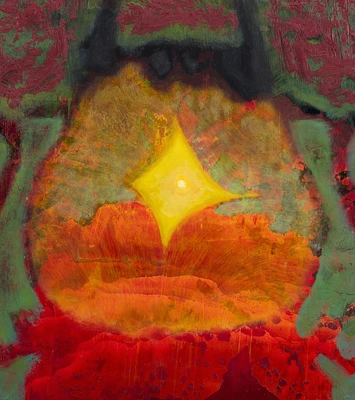
Stephen McKenna had a long career that spanned abstraction, figuration and a deeply personal engagement with classical tradition and modernity. In the 1960s, when McKenna was in his ‘20s and living in London, he embraced a period of remarkable creative freedom that saw him move fluidly between abstraction and evolving figurative modes. In these early works, including Untitled (1967) and Tree with Helicopter (1967), McKenna assembles vivid fragments of shape and colour in multi-chromatic compositions. Later on, figures began to emerge within these dynamic fields. The paintings from this formative period of McKenna’s career are defined by a quest for expanded consciousness and his belief in the power of the imagination, reflecting the ideas of the 1960s avant-garde, absorbing the legacy of Surrealism and the influence of European pop culture.