ArchiveExhibition
Language Between Us
26 Mar-25 Apr 2026
Pippy Houldsworth Gallery
London W1B 4BT
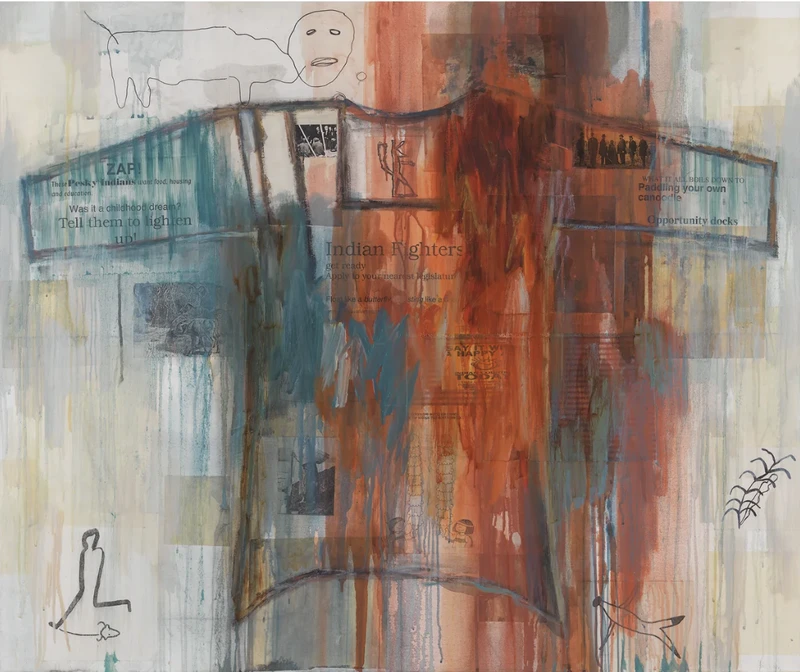
Jaune Quick-to-See Smith, I See Red: Indian Fighters, 1998
Pippy Houldsworth Gallery is pleased to present Language Between Us, a group exhibition of works by contemporary Native American artists James Luna, Mario Martinez, Jaune Quick-to-See Smith, and Emmi Whitehorse. Working across a diverse range of media, including painting, drawing, performance, video, and photography, each of these four artists explores cultural resilience in the face of continued efforts to eradicate and displace Indigenous independence. While complex themes of identity, colonisation and historic injustice are interrogated throughout, of equal importance in each artist’s work is ancestry, place, and spiritual tradition. Despite parallels between each of the artists, Language Between Us ultimately illuminates the plurality of Indigenous identity and the myriad ways in which its contemporary expression resists any single definition, acting as a powerful conduit for resistance and remembrance from a personal and collective perspective.
Both Jaune Quick-to-See Smith and James Luna advocate for Indigenous American communities throughout their work, bringing activism and education into their practices and critiquing the fetishisation and objectification of their cultures. A citizen of the Confederated Salish and Kootenai Tribes, in her I See Red series Smith harnesses the colour red as a symbol of anger, while also referencing the pejorative nomenclature ‘red Indian’ applied by settlers in North America in the late 18th century to those forcibly displaced by land seizure. Both I See Red: Fry Bread (1995) and I See Red: Indian Fighters (1998) feature a single image traditionally associated with Native American life outlined thickly in black, presented within a field of news clippings, advertisements and gesturally applied paint, redolent of the visual languages of postmodernists such as Robert Rauschenberg and Jasper Johns. In her engagement with the canon of 20th century American art, Smith re-centres Indigenous culture, honouring its histories while exposing prevailing stereotypes.
Of Luiseño, Puyukitchum, Ipai, and Mexican heritage, James Luna was equally damning of the Western ideal of the American Indian in his multimedia practice. End of the Frail (1993) critiques James Earle Fraser’s 1894 sculpture, End of the Trail, made as a comment on the declining Native American population, and which glorifies the notion of the ‘noble savage’, depicting a Plains Indian bowed over a weary horse, his clothes in tatters, spear grazing the ground. In Luna’s collage, the artist himself is slumped atop a wooden sawhorse, an empty liquor bottle dangling from his hand, speaking to the crushing effects of nostalgia, denial, and liberal guilt on Indigenous communities. Drinking Piece (1986), in which Luna silently drinks a six-pack of beer, equally explores the generalisations and misconceptions around alcohol abuse amongst Native Americans.
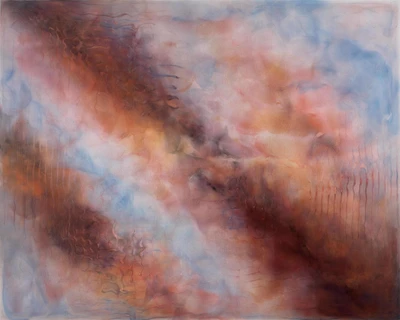
The debate over land stewardship is at the heart of Navajo artist Emmi Whitehorse’s practice. Her mixed media paintings are meditative and layered, inspired by time spent in the American Southwest, registering the subtle shifts in light across the plains, rocks, and deserts. Whitehorse eschews traditional landscape painting in favour of an abstracted visual language that invokes symbolism and sensation to express her intuitive connection to nature. In an untitled work from 1995, organic forms emerge from a vaporous field of red, evocative of endemic flora and fauna. Whitehorse’s practice draws on the Navajo philosophy of Hózhó, an understanding of the harmonious balance of the soul, the mind and the body with the natural world.
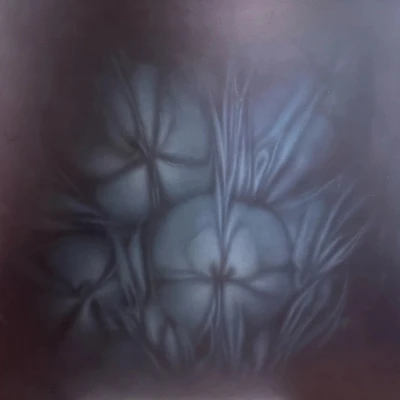
Mario Martinez’s visual language is likewise free from strict representation, conjuring instead a range of associative images that affirm his deep reverence for nature and ancestral territories. Drawing on the spiritual traditions of the Yaqui people, Martinez creates compositions that make oblique references to pre-Columbian forms and patterns, demonstrating his ongoing engagement with his heritage and Southwestern origins. Celestialscape (2001) invokes key symbols from the artist’s visual arsenal, including serpentine forms and flowers. The latter is a recurring motif that connects with the Yaqui ceremonial tradition of the deer dance, a ritual that represents the struggle between good and evil, and balance with nature. Both Whitehorse and Martinez endeavour to preserve Indigeneity and protest colonial violence and exploitation in their work, while deliberately avoiding the disclosure of ancestral symbols to the masses by harnessing the sensorial rather than tangible.
About the artists:
Jaune Quick-to-See Smith (b. 1940, St. Ignatius Indian Mission, Flathead Indian Reservation, MT, d. 2025, Corrales, NM) was an enrolled Salish member of the Confederated Salish and Kootenai Nation, Montana. Smith received her Associate of Arts Degree at Olympic College in Bremerton, WA in 1960, her BA in Art Education from Framingham State College, MA in 1976, and her MA in Visual Arts from the University of New Mexico in 1980. Her recent institutional solo exhibitions include Zimmerli Art Museum, Rutgers University, NJ (2025); Saint Louis Art Museum, MO (2024-5); and The Whitney Museum of American Art, NY (2023), the first retrospective at the museum dedicated to a Native Artist, which travelled to The Modern Art Museum of Fort Worth, TX (2023-4) and Seattle Art Museum, WA (2024). Her collections include Walker Art Center, Minneapolis, MN; Smithsonian American Art Museum, Washington D.C.; Museum of Modern Art, NY; Brooklyn Museum, NY; Metropolitan Museum of Art, NY; Whitney Museum of American Art, NY; Museum of Fine Arts, Boston, MA; Museum of Modern Art, Quito, Ecuador; and The Victoria and Albert Museum, London, amongst others.
Emmi Whitehorse (b. 1957, Crownpoint, NM) lives and works in Santa Fe, NM. She is an enrolled member of the Navajo Nation. She is currently the subject of a two-part solo exhibition at the Wheelwright Museum of the American Indian, Santa Fe, NM, which will extend throughout 2026. Across her six-decade career, solo institutional exhibitions have also been held at Boulder Museum of Contemporary Art, CO (2006); Joslyn Art Museum, Omaha, NE (2001); Tucson Museum of Art, AZ (1997); and Wheelwright Museum (1991). Collections include Brooklyn Museum of Art, NY; Crystal Bridges Museum of American Art, Bentonville, AR; Denver Art Museum, CO; Eiteljorg Museum, Indianapolis, IN; Heard Museum, Phoenix, AZ; Montclair Art Museum, NJ; Museum of Fine Arts, Santa Fe, NM; Peabody Essex Museum, Salem, MA; Tucson Museum of Art; AZ Westfalisches Museum, Munster, Germany; The Wheelwright Museum, Santa Fe, NM; and the Whitney Museum of American Art, New York, NY, amongst others.
James Luna (b. 1950, Orange, CA, d. 2018, New Orleans, LA) was of Luiseño, Puyukitchum, Ipai, and Mexican heritage and lived on the La Jolla Indian Reservation in Pauma Valley, California, from 1975 until his death in March 2018. His works and performances have appeared in the New Museum, NY (1990); Museum of Modern Art, NY (2009); San Francisco Museum of Modern Art, CA; Los Angeles County Museum of Art, CA;National Gallery of Canada, Ottawa; Museum of Contemporary Native Art, NM (2015, 2018); Museum of Contemporary Art San Diego, CA (1987, 2019); and Whitney Museum of American Art, NY (1993, 2019). He has received numerous grants and awards throughout his career, including a Joan Mitchell Foundation Painters & Sculptors Grant in 2010. In 2005, he was selected as the first Sponsored Artist of the Smithsonian’s National Museum of the American Indian presented at the 51st Venice Biennale (2005).