ArchiveExhibition
John Riddy: Winter Landscape
30 Apr-25 Jun 2026
PV 29 Apr 2026, 6-8pm
Frith Street Gallery
London W1F 9JJ
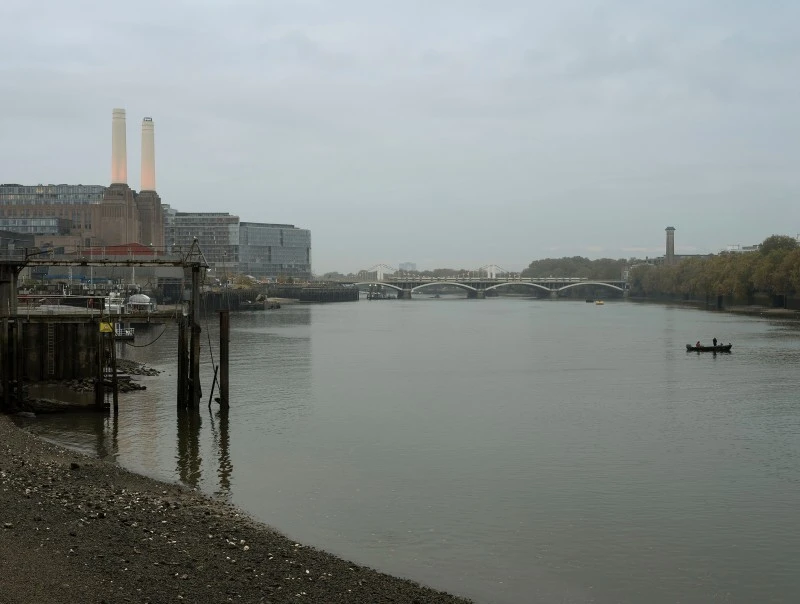
Frith Street Gallery is delighted to present Winter Landscape, an exhibition of new photographs of London by John Riddy.
Riddy’s images are recognised for their attention to the atmosphere and ambience of specific places. Approached with formal precision and technical accuracy, the clarity and resolution of his photographs is achieved by returning to his subject time and again before carefully editing and printing in his studio. While Riddy has documented London before, the previous works in Half-Light (2015–17) and Low Relief (2006–9) focussed on the stillness and permanence of the city’s surfaces and architecture, avoiding the inclusion of people and movement and rendering the city as a series of empty stages. By contrast, in Winter LandscapeRiddy frames and includes temporal elements that traditionally make up a wider landscape view.
The sky, the Thames, parks and railways, all appear as changing backdrops, often for moments of fleeting social engagement. Where previously the urban stage was unpopulated, here we see football played in a local park, a bustling press conference outside parliament or a crowd gathering on New Year’s Eve. By picturing these scenes, the artist seeks to create a more complex description of place and one that is more variable and harder to resolve in the frame. Summarising his reasons for searching out less predictable views, Riddy says “If you remain in control all the time, you only make what you already understand.”
Having trained formally as a painter, and being largely self-taught as a photographer, Riddy has always looked to the history of art and architecture when thinking both theoretically and compositionally about his work. For him, this new series is both a description of place and a kind of social survey, not unlike the 17th century Dutch ‘Winter Landscapes’ of Hendrick Avercamp or Abraham Beerstraten. In their paintings, the seasons and the environment served as a backdrop for social activities, whilst many of the compositions were dramatically divided between foreground and background, often organised around rivers and lakes. The photographs in Riddy’s new series have likewise all been taken in the winter months, often from an elevated position, and featuring the river Thames as a key compositional axis. The need to work in a light-footed manner, sometimes using a hand-held camera, also echoes the interests and methods of Impressionism where the traditional values of history painting are left behind for the immediacy of everyday life.