ArchiveExhibition
The Ground Beneath Me
6 Feb-12 Apr 2026
Nunnery Gallery
London E3 2SJ
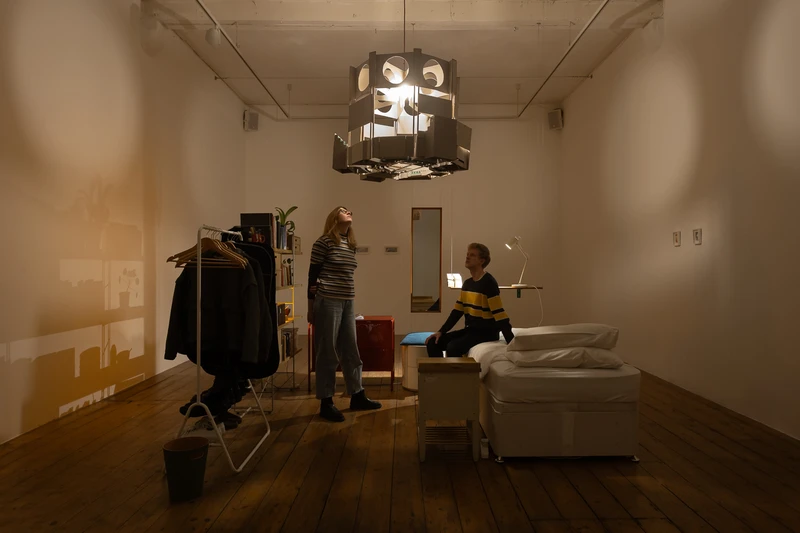
Everything I Lived With, 2026. Credit: Rob Harris
The Ground Beneath Me is told from the position of someone standing inside the artist’s bedroom, wondering where he is, what he is doing, and when he will return. Hoque has relocated his entire bedroom – including every object, item of furniture, and personal artefact accumulated during his life in London – to the centre of the gallery. Laid out to the exact floorplan of the original space, the installation forms a room within a room. Without walls, it remains exposed and held in suspension.
Called away to Bangladesh due to his father’s ill health, Hoque spent the past year living and travelling away from this room. During this time, he tended to familial responsibilities while navigating complex emotional terrain and a persistent longing to return, as Bangladesh experienced the aftermath of a turbulent political transition following the fall of a party that had been in power from 2009 to 2024*. In the artist’s absence, the room holds pain and frustration, offering a view of a life paused, sustained, and left behind. Visitors are invited to move through and engage with the space, revisiting their own memories.
At the centre of the installation hangs a cardboard lampshade, suspended from above. Constructed as an architectural model of the General Assembly Hall in the National Parliament Building of Bangladesh, it illuminates the artist’s belongings that were once stored in his rented room in London.
The surrounding gallery walls present Scenes from Departure (2025), a series of drawn boarding passes that mark repeated departures from the room. Each ticket is overlaid with scenes depicting fleeting encounters, periods of despair, and moments of tranquillity. These drawings record images the artist wanted to photograph but could not, or felt it was not right to capture, yet still wished to remember. Together, they trace where he was while the room remained still.
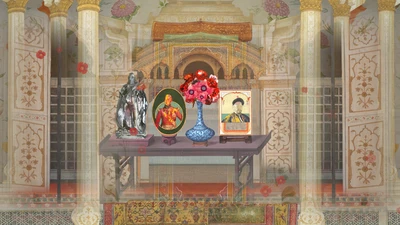
Further along the nave of the Nunnery Gallery, an excerpt from Hoque’s new film Legacy of a Heart’s Injury (2026) premieres. The film forms part of a longer work currently being developed as part of the Film London 2025–26 FLAMIN Fellowship. It documents a conversation between the artist and his friend as they reflect on the grief they separately experienced in 2009**. For Hoque, this was a time of constant emergency, marked by his father’s illness alongside a national crisis. During that same period, his friend lost her father. After losing contact, they reconnected fifteen years later.
Throughout the film, family archives – including photographs, holiday videos, and medical records – become entry points for discussing wider political histories. Through conversation, the friends revisit their parallel experiences in an attempt to understand both personal and national events. The film concludes with the artist’s father sitting on a beach, speaking about politics. Personal loss and public history interlace, as grief, survival, and national memory move alongside one another.
This film contains flashing lights and discussions of death and violence, which may be distressing for some viewers.