Overview
Gagosian is pleased to announce an exhibition of new sculptures and recent photographs by Rachel Whiteread. The exhibition title, Substitute, resonates with the artist’s use of one medium to echo another, and to the way in which her casting process replaces negative space with physical substance.
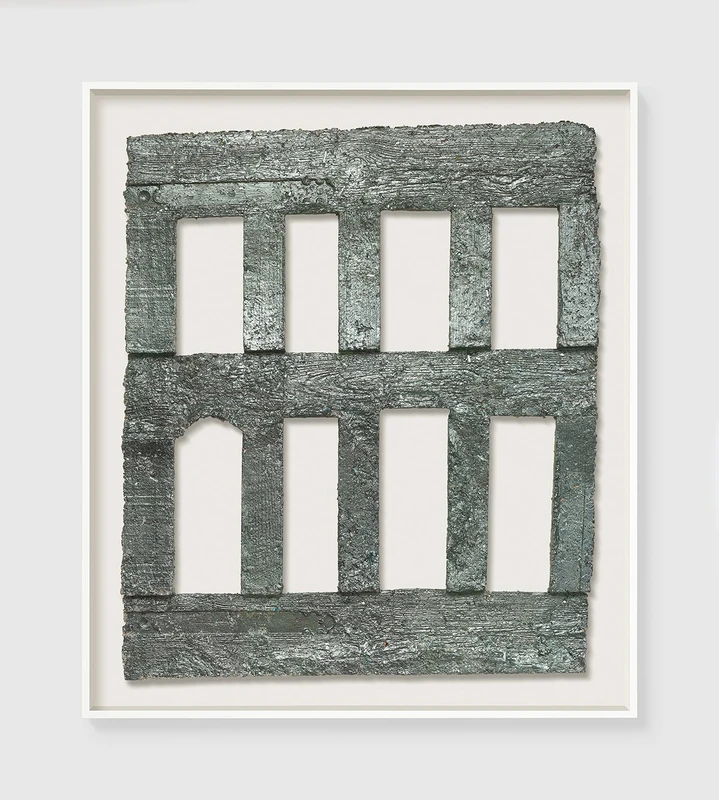
Substitute features large, wall-mounted sculptural reliefs produced by pressing papier-mâché pulp onto timeworn wooden barn doors and sections of gates, then covering the resultant forms in pigmented silver and copper leaf. In contrast to these opaque metallic surfaces are two transparent resin casts of sash windows in blue and pink hues.
In her sculptural practice, Whiteread often uses standard industrial substances such as concrete, resin, and rubber, as well as more traditional materials like plaster and bronze, to produce cast objects with significatory presence that evoke absence, memory, and loss. Building on a foundation of Minimalist aesthetics, she focuses on the tangible surfaces of life, revealing lingering markers of age and use while drawing attention to negative space.
Traditionally used as a preliminary cast for sculptures, or for childhood projects, papier-mâché has a recycled composition that invites dialogue with the past while providing a tool for new creation. (In this, Whiteread’s new works are reminiscent of Embankment[2005–06], her project for Tate Modern’s Turbine Hall, which comprised more than fourteen thousand cast polyethylene boxes, the raw material of which was reprocessed after the exhibition to make street furniture.) As a young artist, Whiteread used the materiality of paper in her transition from painting to sculpture; in Substitute it continues to provide a link between the two practices. The highly textured surfaces of these works are imbued, too, with traces of their own histories, while the finishes conjure the sensation of cool metal in unexpected shades.
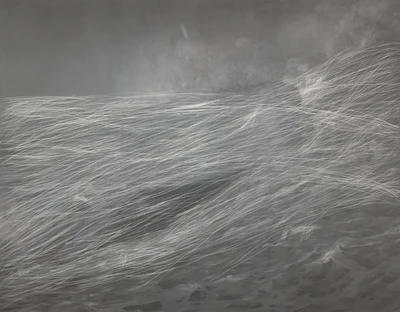
In the rear gallery, Whiteread juxtaposes new small-scale sculptures in fiberglass—a new material for her—with photographs. The sculptures are casts of objects found by the artist during “mudlarking” beach walks. Painted in different bright colors suggestive of seaside leisure, their sizes and positions also liken them to clustered seating. In this, they recall such earlier projects of the artist’s as Untitled (6 Spaces) (1994), a set of polyester resin forms cast from the empty spaces beneath chairs. Whiteread’s photographs also record serendipitous everyday discoveries. Documenting low-key material incidents and alignments, their poignant tone hints at a kind of abandonment. Some shots echo her sculptural practice in their capturing of both positive forms and negative space, while others share its often muted palette.
Seen together, Whiteread’s sculptures and photographs invite sustained reflection on the relationship between natural and constructed forms, and on the memories embedded within familiar objects, places, and structures.