Overview
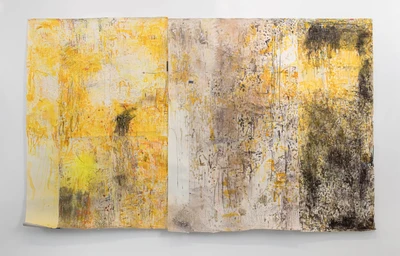
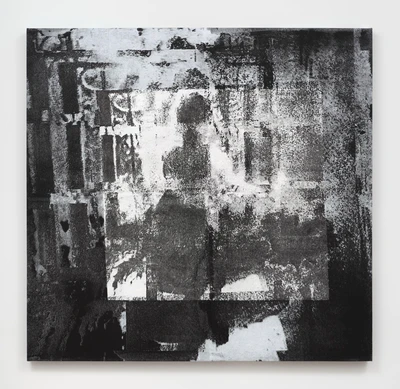
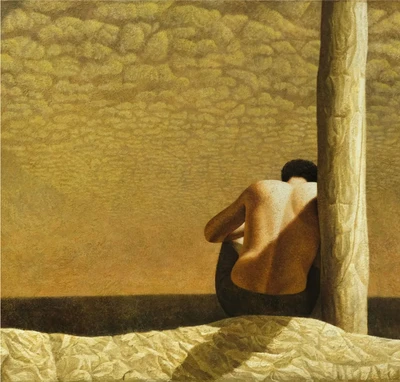
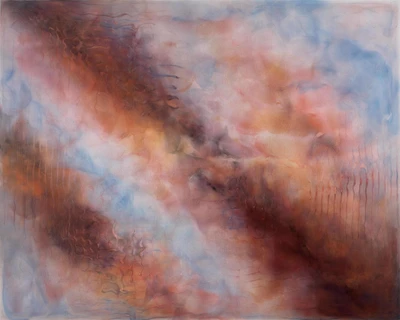
JGM Gallery presents Mirror City, an exhibition of works by nine artists who are engaged with the continuum of abstraction and non-figurative art in the United Kingdom.
The exhibition’s title references the third volume of Janet Frame’s autobiography, The Envoy from Mirror City (1985). Frame uses the metaphor of a Mirror City as a place where she (the envoy) can ponder her lived experiences, and from where she transforms these experiences into literature. Mirror City describes the space between the facts one receives from the physical universe and what one creates from them, a space of attunement to sensation, memory, emotion and imagination.
Featured in this exhibition are two works by John Hoyland (b.1934 − d.2011), a forerunner of British non-figurative art in the post-war period. Hoyland believed in the deep expressive potential of abstract art. Originally inspired by the American Abstract Expressionists, Hoyland was never content to sit still, and his later paintings sought inspiration in cultures widely dispersed in time and space. For him, art was “about making transformations” and “finding the images that lie behind emotions produced by the mind, hand, eye, memory and heart” (Hoyland, 1994). This ambition is reflected in works by the eight accompanying artists who, like Hoyland, are engaged with finding a visual language to represent complex metaphysical responses to our embodied experience of the world, as visual spectacle, physical process, or as social and political structure. In the words of Mirror City’s curator, Sam Cornish, the nine artists are “searching for meaning and pictorial intensity with definite if not predictable purpose” (Cornish, 2026).
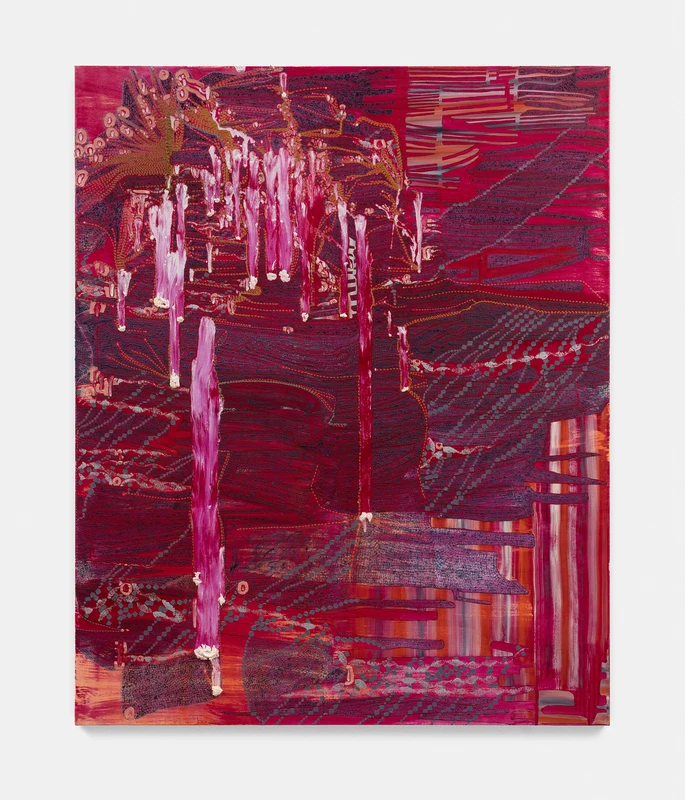
One of Mirror City’s exhibiting artists, Katie Pratt, speaks of her paintings as if they are working documents, spaces in which she can work through her thoughts processually (Pratt, 2022). A particular line of questioning which Pratt follows is how pace, direction and emphasis shape a work of art (Pratt, 2019). This frees Pratt to explore the possibilities of colour, texture, pattern, form, composition and materiality. From her initial marks, Pratt will notice recurrences in the appearance of her painting and build on this repetition, broadly establishing a set of rules for each work. As she follows pathways which reveal themselves gradually through the process of painting, Pratt’s canvases begin to teem with a network of various repeated and incidental marks. One of her exhibited pieces, Mateidio (2025), evolves from a gestural first layer, to which she responds with marks of greater intensity, order and density. While Pratt makes these marks somewhat intuitively, the forms created from them may remind the viewer of electronic circuitry, neural mapping and carrier waves. In a sense, the symbolism of this imagery − of interconnection and transmission − reflects the method through which Pratt made the work, and its purpose.
Gesture plays a large part in the success of the exhibiting artists’ work, though it is, as Cornish says, sometimes overemphasised in current abstract art. It is arguably the artists’ honing and synthesis of their gestures, which they use to express aspects of the metaphysical world, that makes their art effective. Cornish writes, “Marks repeat, creating pattern and structure. They mirror each other, mirror the total structure of the image they create and exist in, and mirror the world beyond the image’s border” (Cornish, 2026). Gesture can be a resolution or restless with uncertainty. Mirror City explores the unfolding of gestures in the exhibiting artists’ works, reflections between those gestures within and between the works, and how these gestures touch the world of the viewer.
Exhibiting artists: Dominic Beattie, John Bunker, John Gibbons, Alexis Harding, John Hoyland, Mali Morris, Lucienne O’Mara, Jacqueline Poncelet & Katie Pratt.