Overview
John Bartlett, Joana Galego, Zebedee Jones, Andrea Medjesi, Rupesh Pushpa Sudhanshu, Kevin Sinnott, Eugenia Vronskaya, Charles Williams, Lisa Wright.
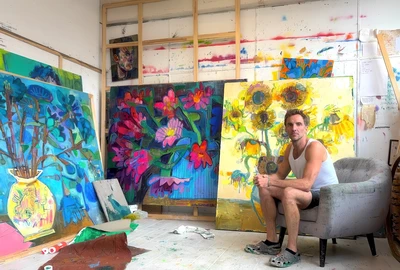
New Art Projects is delighted to present an exhibition of contemporary painting curated by Charles Williams. In this show Williams seeks to look at the origin of influences on his own practice as a painter, and that of his contemporaries. The show draws on visits to museums that lead to certain historical works resting in the conscious and subconscious mind.
Williams observes that: “Like most artists educated in the 1980s and 90s, my art history comes from a hotch-potch of Cultural or Contextual Studies courses, discussions with studio lecturers, and poring over books from the College Library. I remember a visit to the Louvre, though, taken largely because a girl I fancied asked if I’d go to Paris with her (I was in the ‘good friend’ category, it turned out) where I discovered a tiny Watteau Judgement of Paris, painted on board, the brush strokes as naked as the figure of Venus, and I realised that the facture was as important to the old painters as it was to us new ones.”
Since that formative visit, Williams has continued looking and understands that “Baroque painting shoved the realism of direct observation into the heady strangeness of Mannerism.” He is particularly interested in the Carracci “and their visit to Venice to soak up Titian and his contemporaries”, and observes that “their resulting works from the 1580s shows an engagement with the real, the everyday, as well as a highly-charged compositional bent which packed the surface to maximum emotional effect.”
"In this period, painting is not about sublime mathematics but about feelings. Annibale Carracci’s Butchers Shop can be read as a deeply engaged, risky and funny comment on contemporary conditions in Bologna under the yoke of the Papal States whereas Ludovico Carracci’s Lamentation uses all his compositional, anatomical, painterly skills to make a supremely disquieting image of the saddest moment in the New Testament. Baroque painting is images with the emotion button turned to 11; that’s its function. It’s full-throttle painting, pushing at the edges of the canvas, bursting out into our world, rich meat, revelling in skin and blood and material. It’s carnal.”
Later movements also provide contemporary inspiration. Rococo painting represents a different world of delight and gentle melancholy. Williams refers to Watteau’s Pierrot, also retrospectively known as Gilles and states that while the painting “may present a clown figure as ‘Ecco Homo’ he is not tortured by a crown of thorns, rather, he is mildly mocked by his pleasant friends, and the viewer is left with the enjoyable business of working out what is being presented. Is it a woodland, a park, a garden, or perhaps a theatre set? Are these people, dressed in fine, silky, contemporary clothes, depicted as an everyday reality, or is it some kind of play? What is going on? Is it all an illusion? But they look so real!”
The English Rococo produced paintings like theatre sets, although not perhaps quite as elegant as the French. Horrid things may happen, but, unlike the earlier visions of the Carracci, they happen in an almost detached way, and the viewer’s attention is drawn instead to the decoration, to the composition, to the air. Williams observes that “GB Tiepolo’s paintings soar upwards, like the petticoats in Fragonard’s painting of the girl in the swing, drawing the eye inexorably. Rococo painting is not of pathos but the contemplation of the pathos of existence, its foolishness, its delusions. Like the very activity of painting.”
For Charles Williams, these two historic art movements function as bookends to his practice, establishing the edges of possibility in his studio. These influences are not immediately visible in the contemporary art arena, but classical influences in contemporary painting are everywhere, just below the surface, referred to and employed. For Williams “old brown paintings seem to hold my attention a great deal and I return to Christ Church Picture Gallery in Oxford because The Butchers Shop by Anniable Carracci seems a generous painting. In trying to understand painting, and investigating how to do it today, I have perhaps gone too far back past yesterday, but the fact is, I enjoy it.”
For this show, Charles Williams has invited a small group of contemporary artists, whose work he also admires, to respond to these ideas through both painting and text, and to whom he is indebted.