Overview
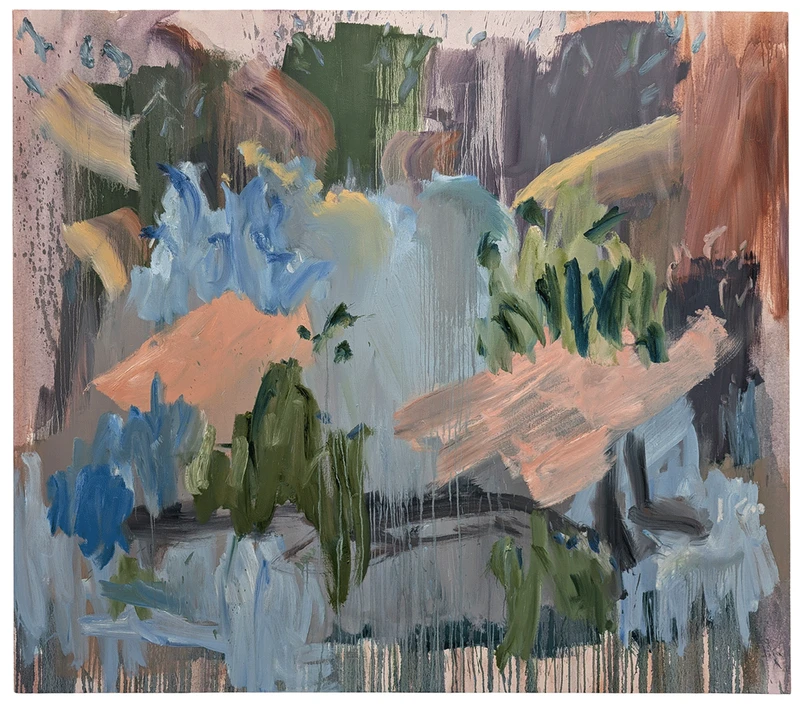
States of Becoming brings together five painters whose practices converge around painting as an unfolding process of fluid activity rather than a vehicle for fixed representation. Instead of approaching painting as a predetermined outcome, these artists regard the act of painting as an open-ended investigation: a negotiation between gesture, time, and memory — exploring how images and meanings emerge and develop through time.
The title foregrounds the transitory and mutable nature of painting, a medium that resists closure and insists on continual transformation, always caught in a state of becoming rather than static being. Layers of paint are added, withdrawn, and re-articulated so that each canvas carries the history of its own making, oscillating between presence and erasure. The paintings reveal themselves through temporal complexity, where the sedimentation of geological strata, evolutionary change, and personal memory interlace, overlap, and resonate. Each canvas becomes both an archive of actions and a space of potential emergence, recording not only what is visible but also what has been concealed, overwritten, or allowed to resurface. Through this lens, the paintings operate as palimpsests of time.
All five artists approach painting as an exploratory practice—an activity that unfolds through repetition, hesitation, and the layering of actions across time. The works invite viewers to consider how meaning is not imposed but continually negotiated, demonstrating how painting can be both a site of memory and a state of becoming.
Artist Statements
Raoul Coombes studied part-time at The School of Landscape Painting under Christopher Baker (2010-14), followed by four years of life drawing at Heatherley’s School of Fine Art (2014-17). He completed an Advanced Painting course at Morley College (2017-19) and was an off-site student with Turps Banana for three years from 2021. Coombes’ paintings depict fleeting moments through colours and shapes intended to encapsulate transient feelings.
The figures in his paintings exist within highly patterned and gesturally painted environments that convey a dreamlike timelessness. He uses shape and colour to depict conscious and subconscious influences, dwelling in transitional states between representation and abstraction. Painted gesturally, the layered paints appear as memories and overlapping dreams, configuring familiar faces and figures. His portraits attempt to describe the subject’s inner landscape through fleeting shapes and evolving forms originating from memories of family, friends and loved ones. These works aim to embed themselves in viewers’ memories, recalled in rare moments of reflection or in liminal states as sleep approaches.
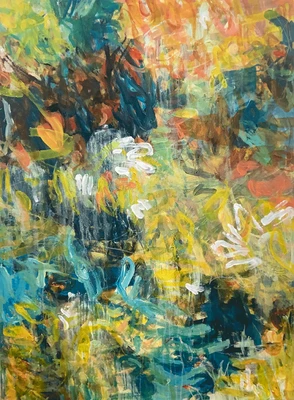
Originally from the West of England, Verity Woolley is an abstract British painter whose large-scale works explore the fragmentary nature of personal memory. Working in oil and acrylic on canvases measuring near two metres, Woolley begins each painting with poetry, drawing specific lines and words from her written work to generate titles and visual directions for her abstract compositions.
Woolley’s practice centres on the way memories naturally fade and fragment—she searches for these lost moments through paint, using incomplete recollection as the foundation for her work. This process of recovery and distortion manifests in layered compositions where colours converse through gestural mark-making and translucent washes that allow the essence of paint to emerge on the surface.Since graduating from Camberwell College of Arts (2019-2022) and completing the TURPs Offsite Programme (2024 - 2025), Woolley has exhibited in group shows within London and the South West. Working from her South London studio, Woolley continues to investigate how personal narratives can be transformed through the anonymity of abstraction, creating paintings where forgotten moments find new form through the physical act of painting.
Mina Courtauld is a painter whose practice is informed by her background in film-making. She graduated from The National Film and Television School in 1993, with her award-winning short films screening at the London and Edinburgh Film Festivals. She transitioned to fine arts through City Lit’s Fine Arts course and Contemporary Painting Studio programme. In 2024, she joined the Turps Off-site programme and is currently on the Turps Studio programme for 2025-26.
Having trained as a film-maker, Courtauld’s paintings incline towards figuration and narrative, while using paint’s abstract possibilities to address metaphorical and emotional meaning. Her early work explored connections between people and animals, investigating our human need to touch and represent other living creatures, and the longing and loss this implies. Recently, she has focused on gesture and stance in the human figure, considering presence and transience.
She works in oils but often begins with a thought written on blue paper—a flash of understanding or recognition of something elusive. The process is akin to poetry in its reduction. Painting becomes a question of returning to that spark of understanding, translating insight into paint on canvas.
Camilo Parra is a Colombian artist based in London. He holds an MFA in Painting from the Slade School of Fine Art, as well as a BA in Fine Arts and a Postgraduate Course in Photography from the Universidad Nacional de Colombia. He also participated in the Turps Off-Site Studio Programme.Parra’s artwork has been exhibited internationally in Colombia, Uruguay, Spain, France, Canada, Portugal, the US, and the UK. He has received numerous grants and accolades from the Ministry of Culture of Colombia and the District Institute of the Arts of Bogota. Notably, he received the Honorific Mention of the Artecamara - Flora Ars+Natura Prize at the international art fair ARTBO (2015) and was nominated for the Chadwell Award (2023) and the Trinity Buoy Wharf Drawing Prize (2024).
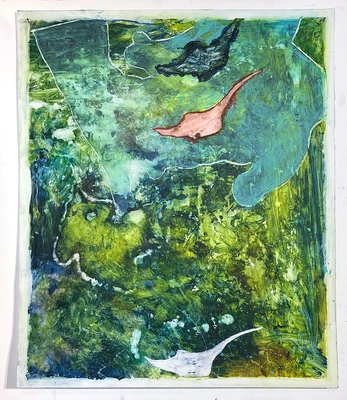
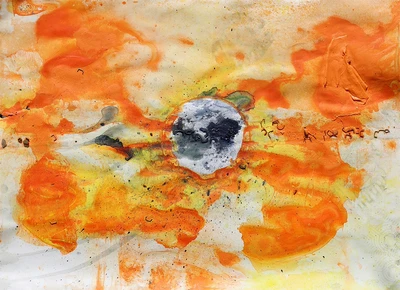
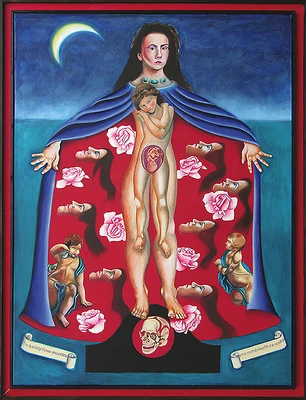
His work explores visual “primordial soups” related to the origin and collapse of the world. Through expansive mark-making and material experimentation, Parra dissects and excavates imagery and visual platforms from science, pseudoscience, esotericism, and religion. This process reveals new, dense, semi-abstract proto-structures that simultaneously emerge and collapse, constantly bridging the macro and the micro, outer space and the inner body.
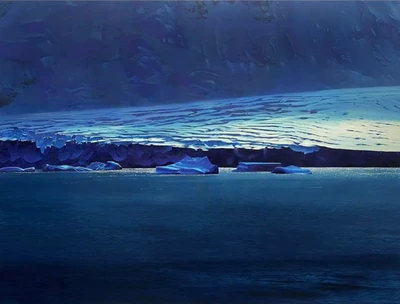
Kate Burnett is a London-based painter whose work explores the unseen—those instinctive, impulsive rhythms that echo through human behaviour and the natural world. Each painting emerges as a kind of living system: layered, unpredictable, and alive with its own quiet intelligence. Rooted in imagined landscapes, her practice engages with ideas of environment, impermanence, and connection, treating painting as a mirror to ecological processes.
Her inquiry centres on materiality, combining traditional media such as oil, charcoal, and graphite with foraged and found elements including scrap metal, pine needles, tree gum, and earth. Through this expanded palette, Kate opens a dialogue between the known and the unknown, the deliberate and the instinctive. The resulting works evolve like ecosystems—through contradiction and harmony, intuition and
accident, structure and entropy. For Kate, painting is both a question and an answer: a space of risk, surrender, and tacit conversation between self, material, and the world we inhabit.
Since graduating from Central Saint Martins in 1996, Kate has built a rigorous studio practice exploring themes of spontaneity, chance, and form. She recently completed the Turps Off-Site Programme (2025), further developing her exploration of painting as a living, generative system.