ArchiveExhibition
Hana Miletić: Diversions
17 Jan-21 Feb 2026
The Approach
London E2 9LY
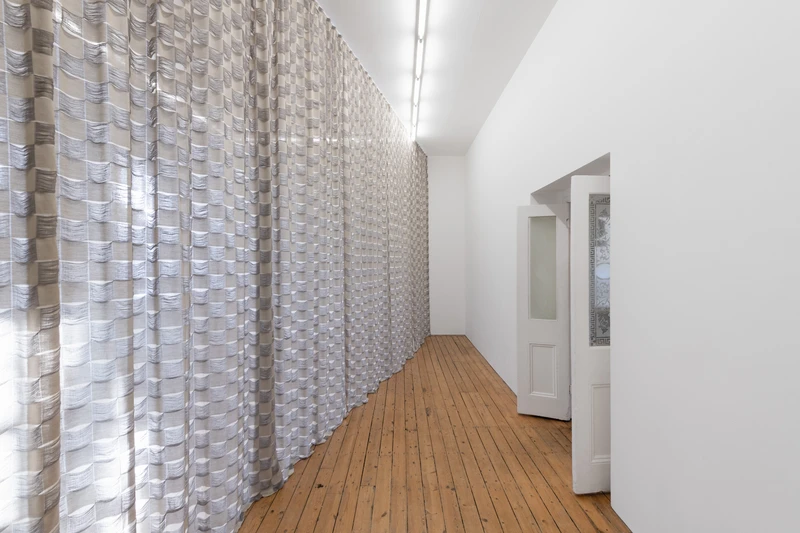
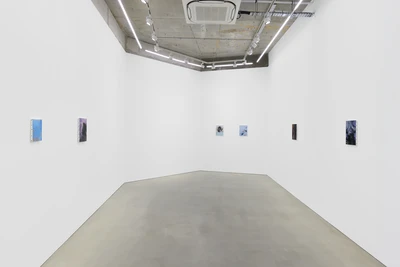
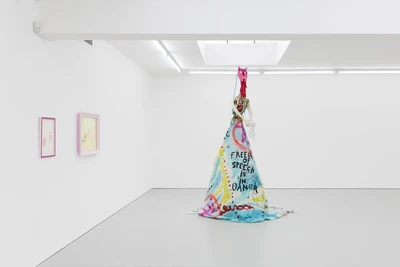
Hana Miletić, Installation view. Credit: Michal Brzezinski
In parallel with CONDO 2026, The Approach is pleased to present Diversions, the second exhibition in the main gallery by Brussels-based artist Hana Miletić (born 1982 in Zagreb). The exhibition features a site-specific installation comprising suspended jacquard-woven curtains and new floor works from her ongoing hand-woven Materials series. As with her earlier exhibition at The Approach, Patterns of Thrift, this exhibition also hints at the location of the gallery in Bethnal Green, which has a rich history connected to weaving and textile production.
By using a jacquard loom to produce the curtains, Miletić is able to create more complex patterns, and at a much quicker pace, compared to her regular technique of weaving by hand. Historically, jacquard looms used punch cards to automate the production of woven patterns, and it was from this lineage that the binary system of 0s and 1s evolved to become the fundamental organising principle for early computing. The chequered pattern is based on the transparency grid found in image editing software such as Photoshop, which underpins all digital images today. Like the transparency grid, the curtains oscillate between opacity and invisibility. Through this work, Miletić brings the connection between weaving and computing full circle: while the fabric pattern suggests a digital editing tool, that precise technology would not have been possible without the loom on which it was made.
Miletić intentionally leaves some of the warp and weft threads partially untethered from the woven structure. This interrupts the standardised, binary processes of weaving, introducing a deliberate ‘glitch’ that demonstrates how even the subtlest shift in an established system can unsettle its underlying normative logic. In developing this work, Miletić considered Marina Vishmidt’s theory of gaps, which forms part of her broader concept of ‘infrastructural critique’. Miletić is interested in the idea that, unlike a void, which implies an absence or something lacking, a gap creates room to reveal the relationship between a space of production and its conditions. Here, we can think of a glitch as a small yet significant gap through which alternative modes of working and thinking can emerge.
The exhibition title, Diversions, resonates across the show on multiple conceptual levels. While the curtains create physical diversions within the gallery, the floor-based works draw inspiration from the sandbags used to anchor road signs that divert traffic. The A-boards, bearing an abundance of warnings, instructions and arrows that redirect movement in the ever-changing Bethnal Green area, have informed the latest additions to Miletić’s ongoing series, Materials (2015–). Works in this series always begin with a photograph taken by the artist – in this case, captured during past visits to London – of repairs or interventions in public spaces. The immediacy of photographic reproduction is slowed down by the transition to a hand-woven sculptural form, which counteracts the violence of representation by replacing a more forensic process with a more situated act of handwork.
The sandbags, reproduced by Miletić, with their lumpy forms, comment on the displacement of sociality in cities and the way in which bodies are reorganised by urban planning and redevelopment. The works also resemble heat-pillows, which are used to alleviate pain and discomfort; as such, Miletić has filled them with cherry pits, drawing on the Eastern European tradition, including that of the artist’s native Croatia. By placing these hand-woven bags within a spatial setting constructed from checkered curtains that allude to a virtual space, the artist aims to reveal and reimagine the various support structures that make up the infrastructures of our lives, whether they be visible or hidden, gentle or hard.
Hana Miletić: Diversions press release
Download