ArchiveExhibition
Massimiliano Gottardi: Zero
23 Jan-28 Feb 2026
PV 22 Jan 2026, 6-8pm
Alice Amati
London W1T 5NB
Alice Amati is delighted to announce the first solo exhibition with the gallery of London-based Italian artist Massimiliano Gottardi’s (b.1989). The exhibition Zero is accompanied by a newly commissioned essay by Italian art historian and poet Ilaria Monti.
Whether benevolent or hostile, fortune has always permeated human life as an ambiguous force: a principle that eludes control; a caprice, grazing our gestures, steering unexpected turns, infiltrating the rituals and the invisible structures with which societies try to tame uncertainty. From the lotteries to contemporary algorithmic protocols, chance remains an opaque presence—a terrain where the unexpected survives logic, where !ifs” and !buts” endlessly proliferate. In the casting of lots, mystery still sparks: Gottardi"s works capture this sparkle, unfolding a narrative marked by corrosive irony and visionary imagination. Hence, the title of the exhibition, Zero, suggesting a conceptual reset that mirrors the unstable terrain of chance itself, and, as the number of absence, becomes a symbol of primordial void and new beginnings.
To trust and entrust oneself to luck as a new form of the sacred may open paths that lead equally to failure or surprise, to algorithmic measure or to the pure blindness of destiny. Rooted in a reflection on space as an emotional device, Gottardi"s practice manifests through architectural forms, everyday materials and gestures, constructing environments, situations, and objects suspended between function and fiction. Creating two interconnected scenarios across the floors of the gallery, his works inhabit the space as ruins of a collective belief, fragments of a cracked-open symbolic language calling for new meanings.
On the ground floor, a constellation of signs and references unfolds through sculptures that act like dysfunctional objects for an unknown ritual. A enlarged 20-faces die - recalling the Platonic solids and their symbolic order, stands as an impenetrable architecture — a kind of futuristic dwelling-body, yet entirely inaccessible: the ghost of a familiar gesture such as throwing a die, turned into a gentle trap laid for fortune and its infinite possibilities. Nearby, the liturgical action of lighting a candle is evoked by a work composed of wax, fire, and electrons. No longer votive practice nor plea, this hybrid candle instead suggests a technological resurrection of hope, the persistence of a wish still to come true.
A small world burning to be seen, a whole cosmology reduced to the intimacy of waiting: for something to shift, for fortune"s wheel to turn our way.
Shifting between access and interdiction, the works engage with the viewer as if they were riddles, generating around themselves a contemplative and fictional space where the ordinary cracks, revealing the ways in which rituals and habits can hold—or betray—our hopes.
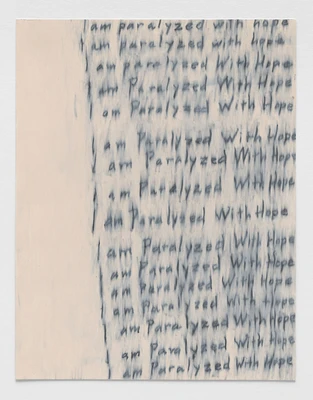
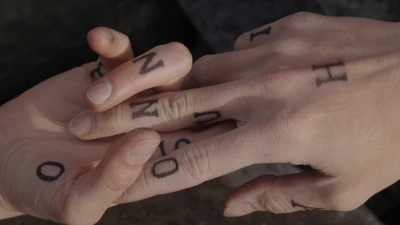
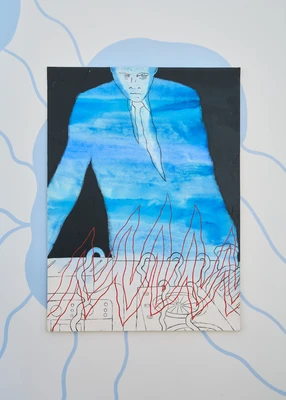
Along the walls, asemic hand-writings retraces distorted remnants of forms, schemes, tick boxes, logos reimagined as contemporary icons — fragments of everyday life paperwork and lottery games mixed and
reorganised into an alphabet of omens. Gottardi crafts an impossible cartography, a labyrinth which offers not an exit, but the sensation of a mysterious, perhaps illusory, order. This site-specific work thus expands as a disorienting maze: another enigma, another unreadable map. If, as René Guénon suggested, symbols act as vessels of truths beyond the phenomenal world, Gottardi"s shattered symbols compose instead an illegible hypertext, unpredictable as destiny itself.
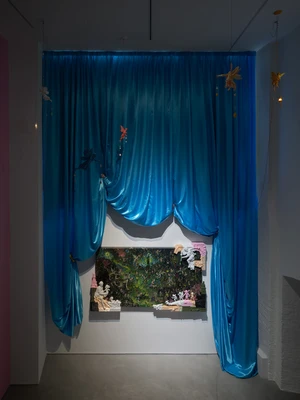
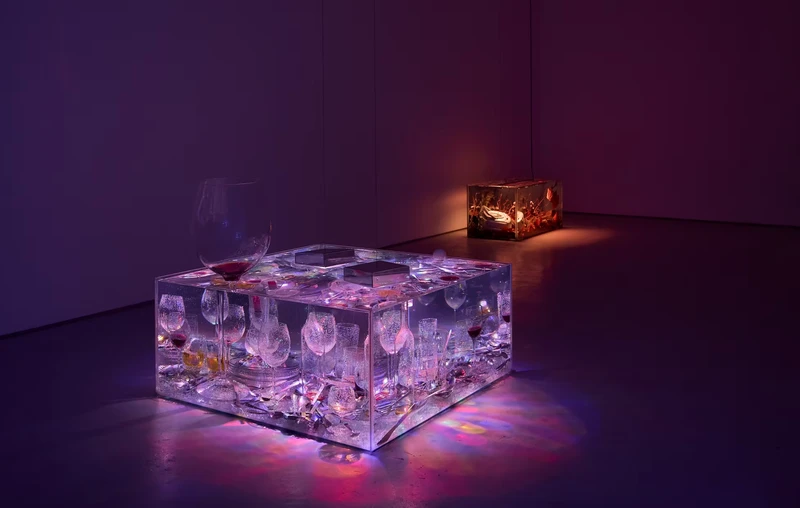
The fortunescape shifts on the gallery"s lower floor, entering the dimness of an aquatic world. Everyday objects drown in the optimism of a glass half-full; broken mirrors, cutlery, household relics float or settle at the bottom of an aquarium, much like leftovers of desires and celebrations, an after-party. As the water holds the weight of sinking wishes, utensils and scraps replace the coins once thrown in hope that a wish might come true. Thus, domestic elements, transient materials, details re-coded from real contexts become instruments for evoking states of anticipation, precariousness, desire, or failure.
Between water and fire, sacred geometry and symbolism, Gottardi revisits the imagery of luck through the language of architecture, light, sound, and sign, delving into ancient and contemporary forms of devotion. In this era of the all-possible, we no longer invoke fortune at the altars but on luminous displays, on digital interfaces generating random numbers and promising possibilities. No longer divine, luck can now be compared to a secret code, a psychological drift, a device which transforms fear and desire into participation; it requires constant negotiations with daily uncertainty, but can also bring unexpected happiness. Gottardi"s work moves through the subtle gradations of chance — nuances the ancient Greeks articulated terms such as τύχη (týchē, blind luck), μοῖρα (moîra, destiny), and καιρός (kairós, the propitious moment). In the uncertain terrain of our human obsessions and vulnerabilities, the artist unveils and sublimates the many shades of fortune through a poetic sabotage of the rules that attempt to govern or predict the unknown. His works shift between liturgy and superstition, between waiting, expectation, and disillusion, between faith, trust, and algorithmic randomness.
Perhaps something good — or terrible — still rests in our hands, in the die we once cast.