ArchiveExhibition
Myriam Mihindou: Common Skin
28 Feb-2 Apr 2026
Phillida Reid
London WC2H 8DY
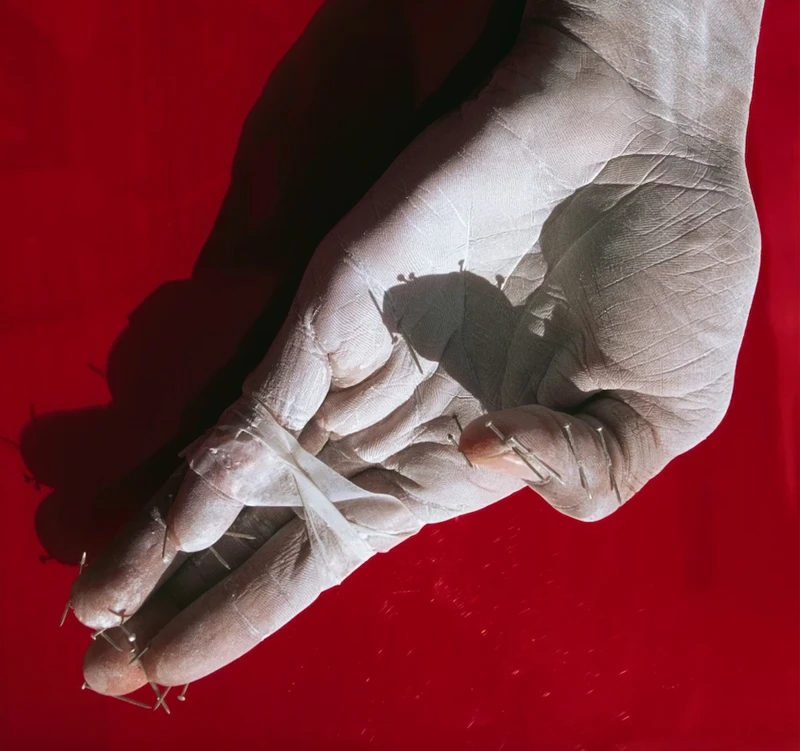
Myriam Mihindou, Sculptures de chair, 1999/2000, Digital colour photograph [Detail]
“My work is a language, and that language says what it has to say.”
Common Skin, Myriam Mihindou’s first solo exhibition in the UK, presents an overview of the Paris-based, French-Gabonese artist’s practice from 1999 to the present day, following her major survey Praesentia at the Palais de Tokyo, Paris and CRAC Occitanie, Sète (2024-2025). Rooted in the body, Mihindou’s work consists of material traces of what she has termed “ritualised creative processes”; concrete outputs or releases resulting from individual or collective performative actions. Common Skin aims to offer an insight into the language of Mihindou’s practice across sculpture, photography, collage and video.
“I conceive of my plastic and visual works as sluice gates, or decompression chambers, that allow bodies to become restored, awoken, and healed.”
Mihindou’s work, in its use of healing or ritually charged substances such as copper, tea, salt and kaolin clay, assumes a therapeutic dimension. Works from Sculptures de Chair (Flesh Sculptures), a photographic series made on Reunion Island from 1999-2000, picture Mihindou’s own hands bound, pierced with pins, and painted with kaolin clay powder, traditionally applied to the skin during rites of passage or trances. “The hand is for me a body”, the process of binding and piercing it becomes “a mental pattern, a way of dealing with the boundaries between the physical and the mental so that the body is no longer a social object but a corporeal subject with its own power of representation”.
In Le Patron (The Pattern, referring to the paper sewing patterns used to construct garments), compositions of fragile papers and textiles are sutured by slender pins, ribbons and visible wire stitches: skins carefully pieced together, repaired. Words are formed from twisted copper, and, in Langues Secouées (Shaken Languages), combined with fragments of rolled and bound dictionary pages, so that words and etymologies become malleable material, a hybrid, marginal language.
Mihindou’s materials possess their own sense of agency: they have potency, history, political associations. Often, her materials threaten to change, unspool, or even to disappear completely. Fleurs de Peau (Skin Flowers, 1999-2024) is a constellation of ex-voto amulets formed from soaps sculpted by use, some grafted using wax and needles, some re-formed in raku, reminiscent of volcanic lava. Strung individually on hemp rope, they retain the memories of the bodies that were cleansed by them, testimonies to processes of purification, caring and healing.
In the 2004 video work La Colonne Vide (The Empty Column), a double image sees two Mihindous standing on stone pedestals, encircling their perimeters like figures in a music box, slipping in and out of sync. The footage – documentation of a live performance of ritualised movements associated with prayer and mourning – gradually dematerialises, fading into white.
Mihindou’s practice operates from the margins of material, language and form. Her works act as membranes or channels, offering passage between states of trauma and repair, contamination and purity, violence and care, fragility and resilience.
Myriam Mihindou (b. Libreville, Gabon; lives and works in Paris, France) is a multidisciplinary artist whose work encompasses sculpture, installation, drawing, writing, photography, video and performance. Her work addresses issues of identity, memory, language, ritual, spirituality, ecology and the notion of limits. She appropriates spaces; embodies them, showing us states of passage, initiatory, and cathartic experiences. Her work explores the physical and mental impacts of traumas caused by colonial or oppressive systems, or what she calls “soul bruises.”
Recent solo exhibitions include Praesentia, Palais de Tokyo, Paris and Crac Occitanie, Sète, France (2024 - 2025); Le sang des limules, Galerie Maïa Muller, Paris, France (2025); Ilimb, l’essence des pleurs, Musée du Quai Branly, Paris (2024); ÉPIDERME, La Verrière, Brussels, Belgium (2022); El Teatro de las memorias, CAAM, Las Palmas, Spain (2022); Silo, Transpalette Centre d’art Contemporain, Bourges, France (2021). Group exhibitions include Exils, Regards d’artistes, Louvre-Lens, France (2025); A garment, a pin, a seam, a shield, Phillida Reid, London (2025); Partenaires particulaires, Fondation CAB Saint-Paul de Vence, France (2025); Les voix des fleuves Crossing the water, Biennale de Lyon, France (2024); PANSORI, Gwangju Biennale, South Korea (2024); Le grand dèsenvoûtement, Palais de Tokyo, Paris (2022); Globalisto, MAMC+, Saint Etienne, France (2022); La sagesse des lianes, CIAP, Vassivière, France (2021); Possessed, MO. CO., Montpellier, France (2020-2021); Confinement: Politics of Space and Bodies, Contemporary Arts Center Cincinnati (2020). In 2022, Mihindou was awarded the AWARE Prize and was in residence at the Villa Albertine, New York, USA, in 2023.
Her work is in the collection of the Centre Pompidou, Paris; Musée du quai Branly - Jacques Chirac, Paris; MAC VAL – Musée d’Art Contemporain du Val-de-Marne, Vitry-sur-Seine; CNAP – Centre National des Arts Plastiques, Paris; Fond d’Art Contemporain – Paris Collections, Paris; Collection de la Ville de Strasbourg, Strasbourg; Fondation pour l’art contemporain Claudine et Jean Marc Salomon, Annecy; FRAC Alsace, Sélestat; FRAC Nouvelle-Aquitaine MÉCA, Bordeaux; FRAC Picardie, Amiens; FRAC Poitou-Charentes, Angoulême – Linazay; FRAC Réunion, Saint-Leu.