menu
Exhibition

2126: What If?

26 Jun-6 Sep 2026

Aspex Portsmouth
Portsmouth PO1 3BF
Overview

Aspex celebrates Portsmouth100 by inviting three artists connected to the city to envision its next hundred years. Exploring themes of sustainability, community, justice, and technology, 2126: What if? encourages visitors to reflect, dream, and contribute to a collective, hopeful future, shaping a visionary narrative that honors the city’s past while looking forward with imagination and purpose.

Alice Hume
Alice Hume is weaver and textile artist based in Portsmouth. Hume has studied textiles internationally at weaving schools in Sweden and Japan, and in 2013 she completed a degree in Woven Textile Design at Winchester School of Art. Her practice is grounded in heritage, community, and the traditions of textile craft. Working on a Harris floor loom alongside smaller looms made by her father, she combines hand weaving with embroidery, knotting, and wrapping, often incorporating vintage and repurposed fibres. In adopting a process-led approach is slow and intuitive, Hume works often unfold organically.

Hume has a strong commitment to sustainable practice, including the use of homegrown flax and natural fibres. Since 2023, she has worked to develop urban textile gardens in Portsmouth, growing flax across the city, and engaging with local communities to learn about sustainable growing practices and the strengthen understandings around the origins of textiles like linen.

Matt Westbrook
Matt Westbrook is an artist, educator and founding member of Grand Union Studios & Gallery. He is from Portsmouth, and now based in Birmingham and the course leader for the Foundation Diploma Art and Design course at Dudley College. He is also a visiting lecturer at Loughborough University.

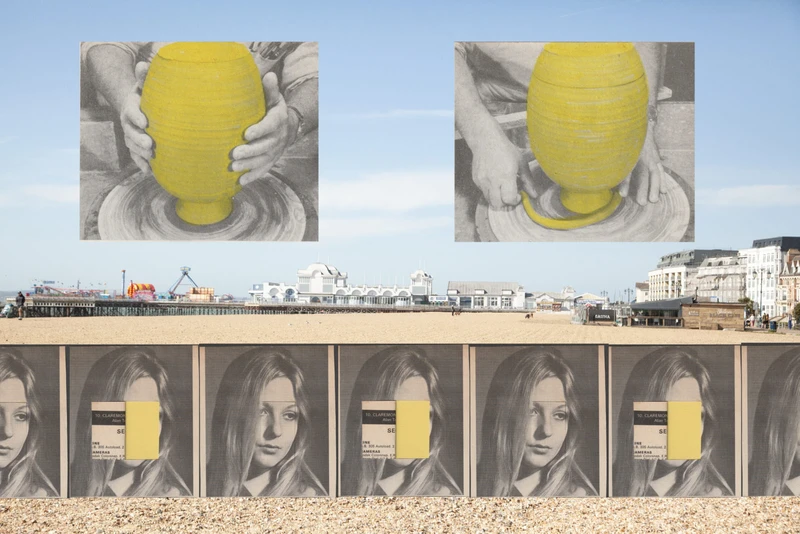
Westbrook’s practice is rooted in an interest in landscape and the built environment, and particularly inspired by the geography of the South Coast. Many of his compositions emerge from walking and direct engagement with architecture or terrain, often reflecting speculative futures or familiar-yet-unfamiliar places. Memory plays a central role within Westbrook’s practice, often guiding the selection of  imagery and response to new contexts. Influenced by Michel Foucault’s theory of heterotopia – ‘other spaces’ that mirror and subvert social norms, works often begin by collecting archive photographic images from scientific, engineering or architectural sources, which are then reassembled into new print or collaged narratives. He often employs artificial parameters to this process, such as only using imagery from one or two sources.

Maria de la O Garrido
Maria de la O Garrido is a Spanish artist who has been living in the UK for the past 13 years. Upon receiving various scholarships from Spain and UK, including The Jane Rapley Scholarship, Garrido completed a BA degree in Fine Arts, later pursuing a Master’s degree in Photography, Practices, and Philosophies at Central Saint Martins University. During this time her approach to image became increasingly multidisciplinary and conceptually expansive, integrating photography and collage in a sculptural manner while also incorporating video and performance into her artistic practice.

The generation and use of archives play a vital role in Garrido’s work, which primarily focuses on analysing elements of her environment that capture her interest and transforming them to create new meanings. Her artistic practice is particularly drawn to the social and political dimensions of art, as well as the unrealised potential within various communities. Believing in the transformative power of art, especially in the current geopolitical climate, Garrido continuously explore ways to create connections and new ways of resistance through her work.