Exhibition
Ansel Krut
19 Sep-7 Nov 2026
domobaal
London WC1N 2ES
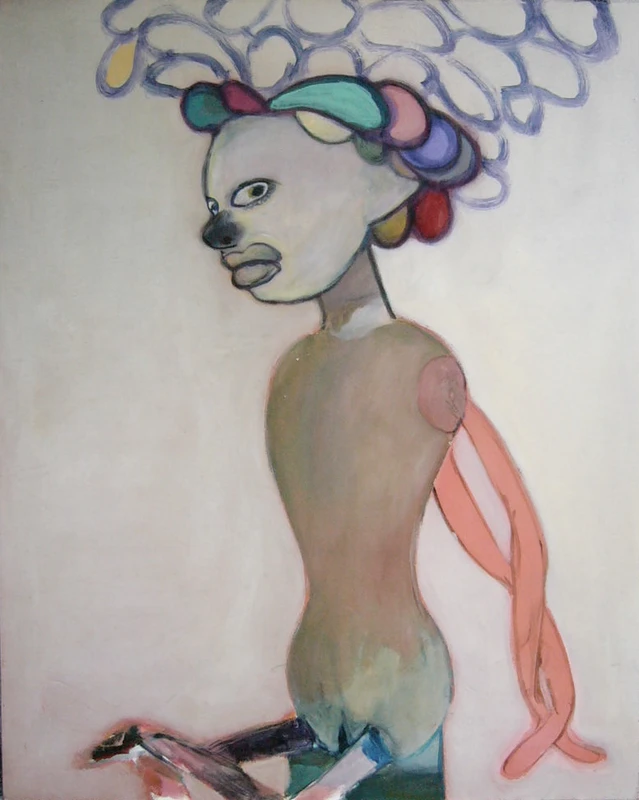
308 in dog years, 2004, oil on canvas. Credit: photo by Andy Keate (private collection)
domobaal is very much looking forward to presenting Ansel Krut's fifth, and maybe sixth (to follow on directly afterwards) solo exhibition with the gallery, this autumn. This will be an opportunity to revisit some of the paintings first shown at the gallery 20 years ago together with newer work.
Ansel Krut: "Twenty years ago I used to go for breakfast at a cafe on the Kingsland Road near my studio. It was used mostly by truck drivers and was always full of cigarette smoke. You could get: bacon, eggs, chips, 2 slices of toast and tea for £2.50. It always seemed to be raining and the passing traffic, which was incessant, sprayed up a fine polluted mist to knee height. Looking outwards from inside the cafe large letters saying "YAWA EKAT RO NI TAE" arched across the whole of the plate glass window at the front (this is "EAT IN OR TAKE AWAY" seen from behind). I was deliriously happy because I had a day of painting ahead of me.
The paintings I made at the time are the ones on show here, and they were, in fact, all exhibited first domobaal gallery. I'm keen to see how they look now; whether they have stood up. When I made them they looked like a wild departure from my previous work and they were met with opprobrium. But the seeds for their making were always there, just buried. I’d spent the previous 20 years trying to learn how to paint the appearance of things, mostly figures, but with limited success, because some of the hidden life of whatever I was trying to paint always wanted to burst through. So then, in my 40's, I felt I had to start to paint less about appearances and more from the inside out, the back to front–ness of stepping into the image and looking outwards.
One more recent painting, 'Faces on Noses' from 2019 has been included to facilitate the conversation between then and now.
"Ansel Krut's extraordinary paintings take us back to 20th century existential angst and its unending inquiry into identity, fate, and self–determination. His painterly style may seem casual, crude, and ludic, but this is work of high seriousness and deep moral content."
(Alfred Mac Adam, The Brooklyn Rail, New York, May/June 2019)
"Amongst fearful iconographic contingencies, such a quietly composed technique quietly nudges the viewer towards the deeper pleasures of the engaged gaze: the compound act of looking, thinking, and translating from painterly matter that reminds us how we differ from animals, and how we might potentially differ more… Somewhere near the heart of this, one feels, is a generalised horror of instability – the possibility that anything is possible, any shift at any moment, even unto self–consumption – and an attempt to use painting, in all its remarkable mutability, as a method of both diagnosing and acclimating to that horror."
(Martin Herbert, from 'Out of the Cradle Endlessly Rocking' written for the pocket–book Hotel Vinegar, published by domobaal editions, to accompany Ansel Krut's solo exhibition, September 2006)
"By turns (and sometimes all at once), they are comical, mythical, scatological and ludic, and appear to have arisen from a ferment of intermingled sources: from the enchanted collective narratives of folklore, to the differently dark ruins of history, to the most trivial of everyday observations, and the flights of imagination that constantly punctuate conscious life. And so they arrive, given body in the messy brisk directness of the drawing process. We are put in mind of Goya's famous 'Sleep of Reason', and the monsters bred therein. But the disturbance is not only a question of imagery; it also arises at the level of material practice."
(Ed Krčma, from 'Ansel Krut – sullyings and inversions and graphic impurity' an essay by Ed Krčma, written for 'Ghost Of A Flea' a solo exhibition and accompanying publication, at The Centre for Drawing, Wimbledon School of Art, September 2007)
"A human–insect hybrid whose expelled innards create psychedelic patterns, a Plasticine–silenced Mickey Mouse–eared demonic baby, a giant–mouthed creature whose teeth operate as a mincing plate into an oesophageal abyss. These are some of the characters you can expect to find in an Ansel Krut painting, while others stretch the capabilities of written description. Krut's works portray a world beyond the everyday comfort zone, where the social boundaries and academic theories upon which we base reality have been bent over and spanked, relativity and Darwinism abandoned in favour of a more fantastical view. The view is rarely pretty, but often funny and disturbing. Krut's dry wit and love of paint provide a welcome veneer between the viewer and a range of abject activities: a sweetshop window onto human perversity."
(Rebecca Geldard, from Ansel Krut: an essay by Rebecca Geldard, to accompany the exhibition 'Lie Still My Beating Heart…' at domobaal, London, May 2004)
"Krut's 'Whistling Winnie' is amazing in that its cartoonish, curiously composite figure comes across as being simultaneously animate and inanimate, and yet conveys real pathos… A word of caution: the work… is best appreciated in the flesh. It's substantially dependent on qualities of texture and touch that tend to get lost in reproduction, common though it is to encounter paintings in the form of mere images."
(Aidan Dunne, The Irish Times, 01.10.08, from a review of 'Precious Things' curated by Graham Crowley at the Highlanes, Drogheda, Ireland)
"Krut is open to letting his images stand as significant, meaning–inducing objects in their own right. Although they are representative and therefore readable as pictures their fluid form places them between fixed, unambiguous representation; certainly one can recognise heads, bodies, rooms, tools, vehicles, situations, but the precise meaning of the image is left for the viewer to extrapolate. There may be more than one meaning "inserted" into the work, or a given picture might well simply operate as a trigger for interpretation, setting up a scene on which the viewer must actively labour in order to come to an acceptable understanding of what is taking place. The standpoint adopted by Krut is one of investigation, of speculation as to what bringing together different pictorial forms might evoke ......The very act of picturing is, by this method of expansion of colour and line, itself pictured. One is reminded of Sigmund Freud's dual notion of condensation and displacement, the two–part process employed in dreams wherein different images are brought together into a third novel form bearing features of both sources, and in which significant items are also displaced or translated into other, sometimes more acceptable entities."
(Peter Suchin, from 'In Wittgenstein's Game' written for the publication to accompany the exhibition 'Maybe a Duck… Maybe a Rabbit…' Ansel Krut, Jemima Burrill and Walter Swennen, at Wimbledon School of Art, curated by Ansel Krut, as part of the Drawing Fellowship 2005–2007)
"Krut demonstrates a Surrealist's facility for perceiving links between the most disparate commonplace objects and having them perform dual functions. It is by attending to the logic that an initial motif triggers, and allowing a character to reveal itself, that the artist arrives at, or discovers, a painting … Nine years ago Krut abandoned a more illustrative style of figuration, executed in a sombre palette, and began working in the singular manner for which he is known today. With this newfound freedom, the artist's sense of colour and humour was allowed to surface. Indeed, Krut claims to now know when a painting is headed in the right direction when it makes him laugh."
(Andreas Leventis, Art Review Magazine, issue 38, January and February 2010)
"The hybrid figures, part human, part animal and part object, perform cruel, ridiculous and crazy antics within the 'stage' of the prepared area … In spite of their grotesque fluency, in a Goya–esque space between absurdity and moral commentary, each drawing is the subject of closest critical attention and processes of editing."
(The Primacy of Drawing by Professor Deanna Petherbridge, Yale University Press, 2009)