ArchiveExhibition
Lubaina Himid and Magda Stawarska: Zanzibar
4 Jun-25 Jul 2026
Lisson Gallery, 67 Lisson St
London NW1 5DA
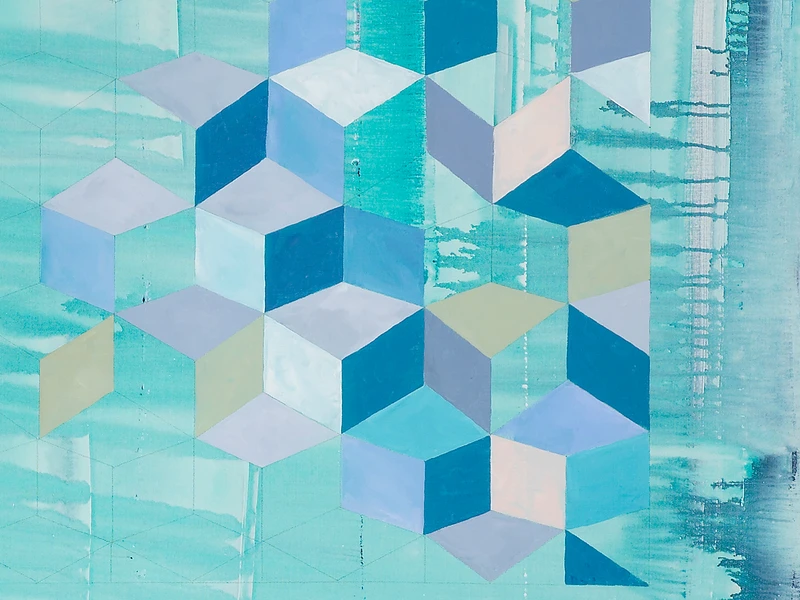
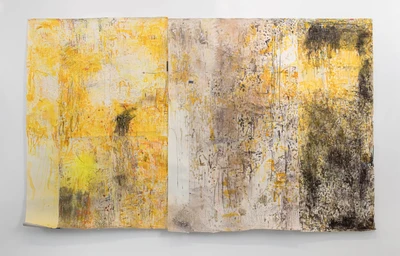
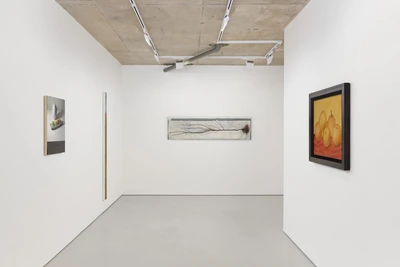
As part of the ongoing Lisson Street programme, the multidisciplinary artistic partnership of Lubaina Himid and Magda Stawarska present a new iteration of Zanzibar (1999-2023). Reflecting on themes of memory and movement, loss and belonging, this immersive and evocative mixed-media installation comprises nine diptychs painted by Himid in 1999, paired with a 38-minute multi-layered “libretto” composed by Stawarska in 2023.
This historical series of canvases floats throughout the gallery – anchored by colourful cuboid forms and recurring zigzag patterns. It represents an anomalous passage of abstract painting and a decisive break from Himid's distinctly figurative, narrative-rich practice, being quite unlike “anything I made before or since,” as she has noted. Entitled Zanzibar, this major suite of diptychs was created as an homage to Himid's East African birthplace and an evocation of memories associated with the archipelago. The paintings reference early events in her life that led up to her coming to London in 1954, hastened by her father's untimely death aged just 33 (her mother was 26 at the time and Himid was just 3 months old). Subsequent trips back to Zanzibar undertaken by the artist are also suggested in depictions of fishing or mosquito nets, shells, tiles, closed shutters and dripping tears.
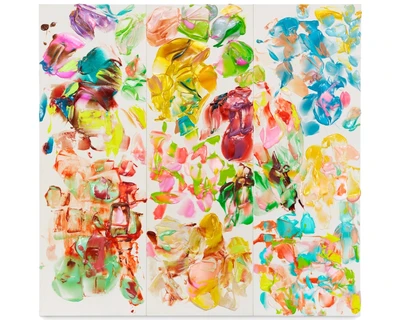
One pair of works, with the title Never Harm a Clever Man, seems to be a lament for the time lost with her father, while aesthetically suggesting a desert landscape or an architectonic aggregation of terracotta buildings. Sprinkled Rosewater is Always Pink, inspired by Himid's recollection of a silver perfume dispenser, sees the surface of both paintings showered with blush petals and spatters of translucent rose-coloured acrylic. Many of the tessellating boxes in Cloves Numbing Warming Soothing Strong contains a single clove, also seemingly representing the smell emitting from a local industry, as much as any visual or symbolic memory.
The eight-channel collaged soundtrack of songs and voices, scored by Stawarska, is layered over and woven through the paintings in the same way as they have been hung throughout the space, in a freeform configuration. The sonic composition leads viewers through the installation and incorporates Taraab music from Zanzibar, snippets of opera, as well as narrated sections of a guidebook given to Himid's mother by her father. Vignettes of life on the island and in the town of Zanzibar in east Africa are juxtaposed with archival BBC radio clips, orchestral music and Himid's own voice. Describing her collagist style, Stawarska called the process ‘a meticulous choreography of technical layering, specifically of keeping time, to maintain the intimacy of emotion.’
Channelling both artists' sense of relative belonging, displacement and loss from their native countries, the overall effect is of a multi-dimensional, fluctuating landscape that evokes past journeys, present desires and future possibilities, spanning more than one lifetime of thought and experience.
This installation mirrors the prolific and ongoing artistic partnership between Himid and Stawarska that is also in evidence throughout this summer at the British Pavilion of the 2026 Venice Biennale. Their almost two-decade working relationship and their ongoing artistic collaboration – combining elements of painting, sculpture, printing, photography and sound – was first realised in exhibition form in 2020 at WIELS in Brussels and has more recently been showcased at Tate Modern, London (2021); the Musée cantonal des Beaux-Arts, Lausanne (2022); Sharjah Art Foundation (2023); Kettle’s Yard, Cambridge (2025); Mudam, Luxembourg (2025) and the UCCA Center for Contemporary Art, Beijing (2025).