Overview
Drawing parallels between today’s AI boom and Victorian invention, They’ve Got Your Eyes examines the motives driving advanced AI, and how fantasies of power shape its development.
Rachel Maclean’s practice spans contemporary art, film, and emergent technologies, frequently starring her as the only actor in elaborate disguise. In this multi-channel exhibition, she swaps costumes for AI models trained on her image and archive, producing a new body of work that explores the tension between artistic authorship and machine agency. In this context, the phrase ‘they’ve got your eyes’ implies not just resemblance but theft – an AI running away with an artist's way of seeing.
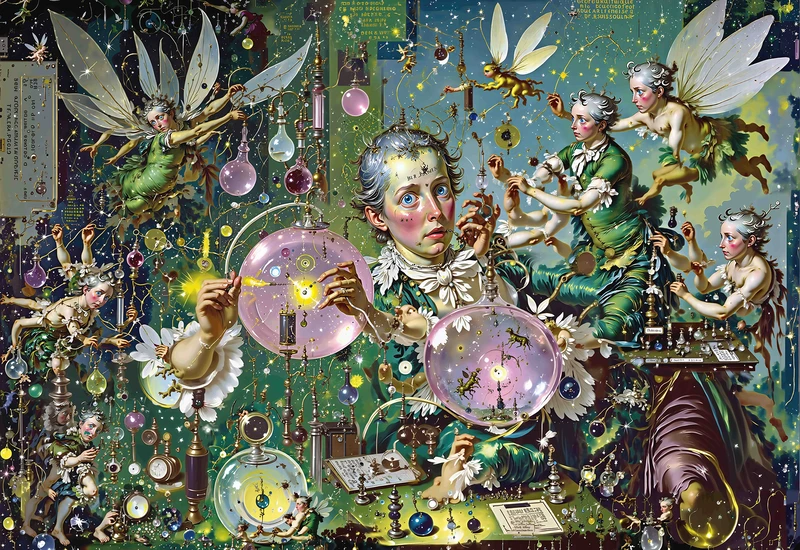
In her new short film, we follow ‘The Gentleman’, a contemporary tech-bro-come-Victorian engineer, who has invented a process for generating fairies. His pursuit of ‘progress’ curdles into jealousy when he realises he’s not alone; another Gentleman can summon fairies too, and with far greater aptitude. As the two men descend into rivalry, their shape-shifting creations flicker between flattery and mockery: at times disarmingly clumsy, at others unnervingly perceptive. Beneath The Gentleman’s mounting God-complex runs a quiet dread: that his fairies know more than he ever could.
Across fragmented screens, we see The Gentleman wrestle with his creations. He commands his fairy to build an aqueduct, but instead she vomits a towering “Aqua Duck.” He calls for a “parliament,” and a lurid green ice-cream cone rises above a shop named “ParlourMint.” AI-generated forms spill into the space as 3D-printed sculptures, dripping with slime and referencing the “AI slop” saturating contemporary visual culture.
They've Got Your Eyes is a response to the ongoing AI arms race, connecting it to the Industrial Revolution and the havoc wrought in the blind pursuit of ‘progress’. The work continues Rachel's recent exploration of power in the age of AI. As ego shapes technological development, how do we disentangle scientific achievement from the darker side of AI’s relentless growth?