Overview
Overview
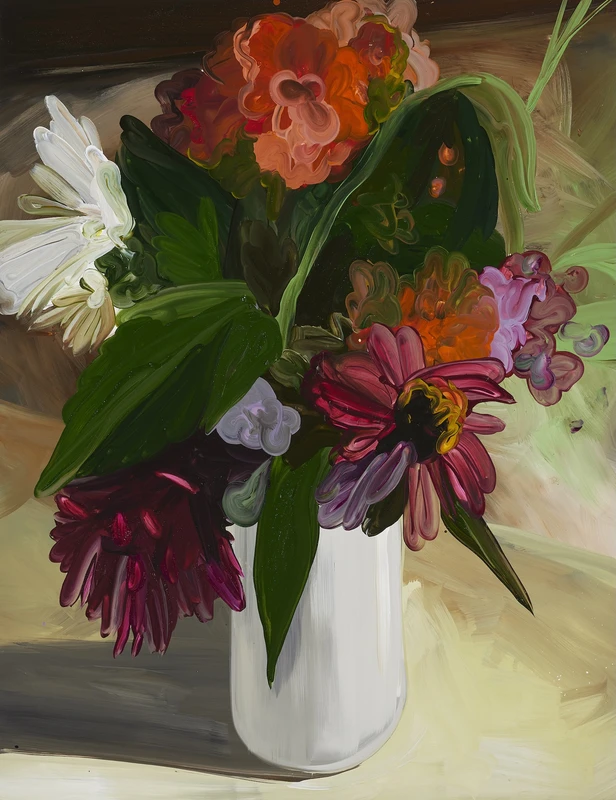
Clare Woods: Garden Without Seasons will feature 29 new and recent works — all created over the last four years — comprising paintings, collages, and prints that are infused with both her trademark wet-look oil paint as well as layers of contemplative meaning.
At the centre of the exhibition are the flora, still life and natural world that Woods returned to during the pandemic, at a time when familiar objects took on a heightened resonance.
By responding to photographs of flowers and everyday items, Woods has created a new visual world of nature that lies between abstraction and figuration — both familiar and ambiguous — where forms are ever-moving through a semblance of oil paint swirls.
Crucially, they act against the rapid flow of imagery that modern photography has enabled, allowing the viewer to consider scenes through a slower and more detailed approach.
Informed by her early training as a sculptor, Woods focuses on the forms of her subjects and the spaces in-between. Now, she has engaged with the historic interiors, architecture, and gardens of Pitzhanger Manor to continue her exploration of not just the natural world itself, but the nature of time, absence, and death.
A number of works prioritise the act of viewing. Looking at the world through windows became the norm during the pandemic, and several works include views mitigated by glass, from boldly colourful red in Cold Case (2025) to greens and dirty yellows found in an abandoned building’s crosshatch window design in Show All (2025) to the multicoloured concentric circles of Trackwalker (2025). The prism of colours that burst through suggests not just one solitary lens from which we view and understand the world, but multiple dimensions beyond the one we can see in her compositions.
Another key glass component is seen in Under The Dome (2024), a monumental painting capturing the rare and threatened flora that find sanctuary in Temperate House at Kew Gardens. Positioned among luscious tropical plants, the view is from the ground up, peering at the Victorian staircase. Crucially, these plants are encased under a glass sky allowing them to thrive and exist; the glass structure representing the thin veneer between life and death — where the cold climate of the UK would otherwise wipe out these species.
This painting was composed from a photograph selected from the artist’s vast studio archive assembled over decades, in a process that is key to Woods’ practice. From one of these photographs, she produces a line drawing which is translated on to aluminium panels primed and coated in white gesso. Finally, Woods paints flat, working wet on wet, mixing the paint colours on the painting’s surface in one extended long session until the painting is finished.
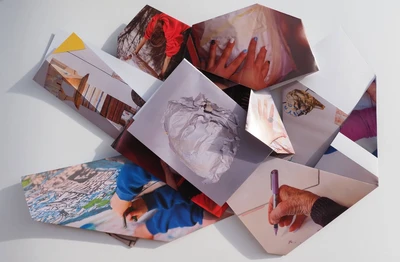
Another integral part of her process is to use all leftover colour from a day’s painting, where the paint is applied on pieces of paper to eventually be used for creating collages, which involves a slower process of tracing, drawing and intricately cutting. The collages, set in coloured frames selected by the artist, are always created after the paintings and a selection of these works on paper will be on display at Pitzhanger alongside the paintings.
The resulting capture of luminescent beauty is also tinged with melancholy or foreboding. Woods’ work is infused with memento mori, including the depictions of flowers sent by friends to her following a stay in hospital, such as Nothing Permanent (2025) — the title indicating the colour and beauty of the flowers that will soon perish. Other still lifes, such as the screenprint Good Humour (2024), play with shadows to conjure a sense of the fleeting nature of time passing.
For Woods, the idea of absence also runs through Pitzhanger Manor, with the building constantly reminding visitors of the presence of Sir John Soane (1753–1837) through his unique architecture and light-filled spaces, although he has long departed. The transitory nature of both flower blooms and human life, and the melancholia that comes alongside these understandings, can be seen in works such as Collage for The Farewells (2026).
Architecture and its relationship to nature is also explored, such as in Initial Wave (2026), derived from a tightly cropped photograph of a chandelier where a darker green, blue and magenta colour palette mimics the jewels found in such decorations, but also likens the resulting scene to a tropical environment. Two screenprints of chandeliers — Puff Ball (2025) and Blow Away (2025) — draw further connections between intricate ornamentation and the patterns found in nature, as both reference dandelions that have completed their life cycle.
These works draw on a long and rich art tradition, inspired by past greats. The vases that hold plants and flowers such as in Laughing out Loud (2024) and The Inside Garden (2025) are reminiscent of Giorgio Morandi’s vessels, while the specific focus on flowers recalls Édouard Manet’s deathbed paintings of peonies, or exuberant Dutch seventeenth-century works reminding their contemporary viewers of the transience of worldly pleasures and the passage of time.
Woods also takes inspiration from literary sources, such as George Orwell (1903–1950) and his Tribune column ‘As I Please’. Written during and shortly after the Second World War, Orwell treated all subject matter with the same importance, from minor irritations like the price of eggs to serious political concerns, and crucially, seven rose bushes he planted in his own garden. In Woolworth’s Roses (2023), Woods displays these roses in a vase in an indoors setting, with drooping petals. Like Orwell’s garden, which was a counterpoint to the events transpiring across Europe, the flower arrangement in this painting illuminates what appears to be an otherwise gloomy interior.
Clare Woods: Garden Without Seasons promises to be a visually stunning walk through the rooms and galleries of Pitzhanger Manor with a contemplative and colourful guide. Visitors will be able to engage with a creative and fruitful moment in a celebrated contemporary artist’s career, where light-hearted moments coexist with images that carry a deep emotional weight.
Enquiries
+44 (0) 20 3985 8888, [email protected]
Book now