ArchiveExhibition
Phillip Lai: RAIN / RUIN
31 Jan-10 May 2026
Spike Island
Bristol BS1 6UX
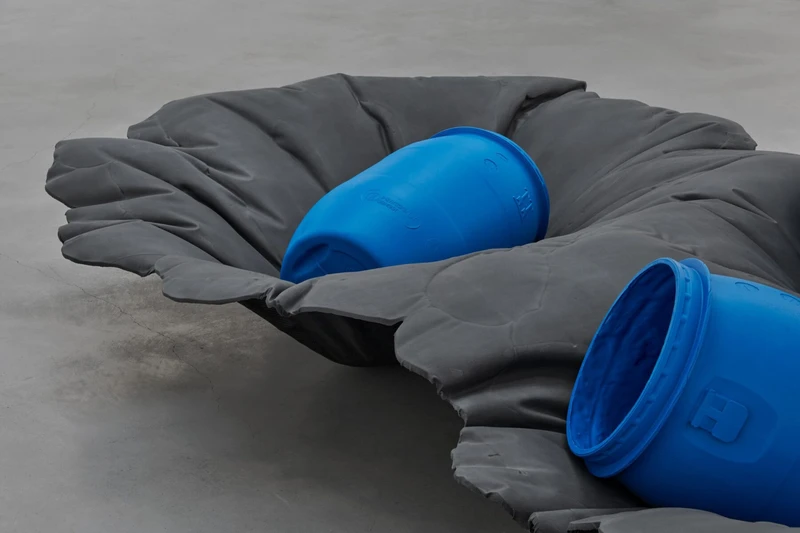
Spike Island presents a major solo exhibition of new work by Phillip Lai (b.1969, Kuala Lumpur), bringing together a body of sculptural commissions that continue the artist’s exploration of the material world around us. This will be the most significant institutional presentation of Lai’s work to date.
Lai’s sculptures combine everyday objects with his own intensive re-makings of them to create a parallel imprint of the real world. Within this familiar visual landscape, he isolates moments of sculptural potential, often by intervening into the industrial processes used to make these objects – often things that provide comfort and facilitate our daily lives. These interventions effect a transformation in the object – a shift, a turn, a slippage – that erodes the logic of its material grammar and leaves you wondering what, exactly, you are looking at.
At Spike Island, Lai returns to familiar types of objects that denote containment: trays, dishes and other receptacles that typically carry food or water, as well as larger vessels like beds or cages that might hold bodies. A strange, cage-like enclosure holds court over Spike Island’s large central gallery. Suspended high off the ground, its galvanised metal form is loosely inspired by observations of urban infrastructure, such as the structures that hold monitoring and signalling equipment. A spectral sonic element pulses through the air, as if its machinic rhythm were an echo of Spike Island’s industrial past. The work simultaneously invokes a sense of peripheral attention and subliminal alertness, while alluding to aspects of management and control.
Elsewhere, a series of low-lying sculptural forms extend Lai’s material engagements, cross-referencing one another in their formal vocabularies as well as in their referential motifs. Lai envisions transfers and retentions of energy within sculptures that suggest the support of basic daily functions: a bed-like form, a tray of food, a basin of water. These flows of energy are also reflected in Lai’s processes, which often incorporate expenditures of kinetic and thermal energy, from metal spinning to bringing materials such as pewter and wax to a molten state in the casting process. Several installations were also instigated by rekindling the latent potential of ideas and processes from earlier video works, such as Introduction (2009). Here, mysterious flares of colourful smoke, set against a black backdrop and presented across multiple LCD screens, are integrated into a new sculptural assemblage, inviting reflections on the passage of time, displacement and transmission.
While Lai’s forms might point to questions of sustenance and survival, these questions do not coalesce around any individual human narrative. Rather, the materials carry the score. The sculptures feel anonymous and transient, located in an uncertain zone where time and space feel somehow out of joint. Many of the works offer in sculptural terms what is plainly present, while also evoking an ungraspable site or a time that is not the present.
Within this interplay of forms, notions of the proximal and the remote, the sacred and the profane, and of surplus, excess and destruction are quietly held in tension. Made using varied materials such as wax, stainless steel, concrete, resin and burnt wheat, each sculpture represents the crystallisation of many slow, attentive processes, often involving multiple castings of objects. As ever, the intricacy of their construction belies the simplicity of their final form.
Phillip Lai
Phillip Lai was born in Kuala Lumpur in 1969 and moved to London in 1979, where he continues to live and work. In 1997, he presented his first solo exhibition at The Showroom, London. His work has been the subject of subsequent solo exhibitions at Kiang Malingue, Hong Kong (2023); Modern Art, London (2021); Galleria Franco Noero, Turin (2019); Edouard Malingue Gallery, Hong Kong (2018); Camden Art Centre, London (2014); and Transmission Gallery, Glasgow (2009).
In 2018, he was shortlisted for the Hepworth Prize for Sculpture, and from 2017–19 was awarded the Sculpture Fellowship at the Kenneth Armitage Foundation, London. His works are held in collections including the Arts Council Collection, London; M+, Hong Kong; Museo Jumex, Mexico City; Sifang Art Museum, Nanjing; and Tate, London.