ArchiveExhibition
Sayan Chanda: How Many Fires, How Many Suns, How Many Dawns?
14 Feb-31 May 2026
De La Warr Pavilion
Bexhill-On-Sea TN40 1DP
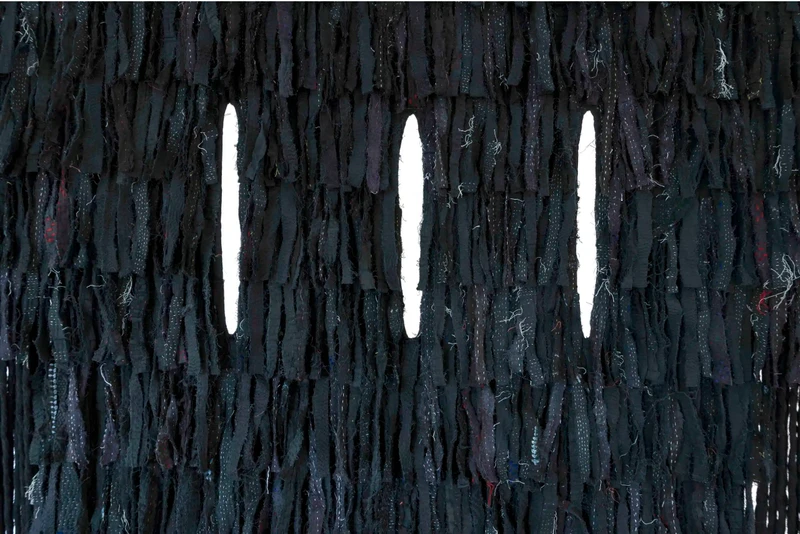
De La Warr Pavilion is delighted to announce a major new commission by Kolkata-born artist Sayan Chanda titled How Many Fires, How Many Suns, How Many Dawns?.
Sayan Chanda reimagines votive objects, folk divinities, and mythic narratives as hybrid, ambiguous forms through the lens of identity and postcolonial theory. Working intuitively with fibre and clay through weaving, stitching, quilting, dyeing and hand-building, he creates spaces where stories, figures and rituals exist untethered from place, culture or period. His practice often turns to female and subaltern deities whose presence endures through communal rituals that have survived in domestic settings or been obscured by patriarchal retellings.
At the centre of the exhibition is Bonbibi, the forest goddess of the Sundarbans, reimagined as a figure that belongs to no single community or faith. Traditionally worshipped by both Muslim and Hindu communities as a protector, she has in recent times been reshaped to fit orthodox Hindu practices. Chanda presents her as a syncretic figure, unbound by rigid definitions. She appears as an expanse of vintage Kantha quilts, hand-stitched by women in their homes from materials drawn from daily life. For Chanda, Kantha is an archive of women’s labour, shaped by necessity, memory and quiet resistance. Through it, Bonbibi becomes a figure of both protection and resilience, rooted in the everyday gestures of care.
Two figures will stand beside Bonbibi, represented in the form of woven and stitched textiles, and will act as both guardians and warnings. Interacting with these works, a still body of water will reflect the environment and reveal glimpses of the deities, holding both calm and a sense of potential change. Scattered across the space will be small ceramic animals and sculptural forms that recall the roots of mangrove trees. Their metallic surfaces will shift between clarity and ambiguity, and some creatures will appear part-human, part-animal, suggesting the connections between humans, animals and the natural world.
The title How Many Fires, How Many Suns, How Many Dawns? comes from an invocation in the Rig Veda, an ancient Sanskrit text that forms part of the oldest Hindu scriptures. It is commonly translated as: “How many fires are there, how many suns, how many dawns, how many waters? I address you, O ancestors, not in rivalry; I ask you, sages, in order to know the truth.” The phrase calls upon ancestral spirits to understand the multiplicity of the universe. It can also be read as a reflection on unity and the ways that all things are connected.
Through this commission, Chanda will continue his exploration of forgotten myths and ancestral figures as a way to consider care, resilience and belonging. By returning to these stories, he will create a space beyond fixed forms of worship or recognition, where deities and histories exist in a porous, shifting terrain.