Erika Trotzig
b. 1971, Sweden
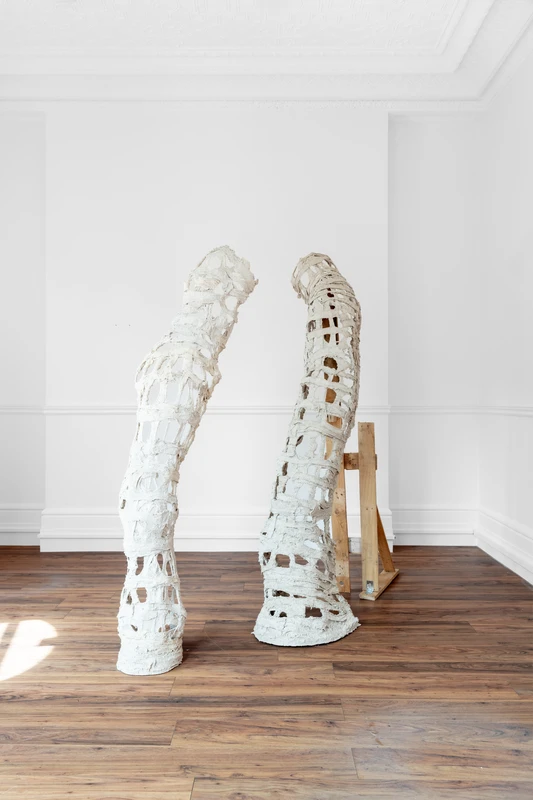
With the romantic sensibility of an architectural folly, Erika Trotzig’s corporeal structures appear on the verge of collapse. Her tactile sculptures, from largescale ‘anti-monuments’ to palm-sized fragments, hover between the human and the architectural, the industrial and the handmade. Her technique is rooted in a formative understanding of texture, volume, and construction. Sensual and undogmatic, these works imagine alternative modes of embodiment.
Born in the coastal city of Malmö, Sweden, in 1971, Trotzig grew up in an artistic milieu: her father and sister painters, her mother a writer. As a young woman at the turn of the millennium, she entered the world of fashion believing it could be art. Conventional design principles and commercial imperatives were courageously forgone, and clothes were imagined as ‘sculptures on other people’s bodies’. Trotzig developed her creative sensibilities working in haute couture in Paris and founded her eponymous label in 2001. Her early garments were unique pieces, gently frayed and intricately stitched; they evolved into an irreverent mode of ‘anti-fashion’ and displayed an intimacy that would come to characterise her wider practice. In 2017, Trotzig began studies in Fine Art, completing a Graduate Diploma in Fine Art at Chelsea College of Art followed by an MA in Fine Art at Central Saint Martins. Interdisciplinary methods informed her sculptural vernacular: surfaces existed to be broken and repaired, layered and challenged.
Emerging from considerations of the body, Trotzig constructs her precarious, unstable structures from found, recycled, and site-responsive materials: foam cushions, reclaimed timber, Berber wool, sand, and cement, among other found objects. She approaches colour as something to be found through her materials rather than imposed upon the work. Working predominantly in neutral monochrome, Trotzig’s forms assume a certain universality. The occasional accent of stronger tone stands in dialogue with the corporeal subject: foam bricks can be buttery, the colour of fat, while shades of pale pink take on a gendered fleshiness.
Quiet histories pervade the assemblage. Old mattresses evoke the absent body; cloth and wool beg for a limb; found objects draw in fragments of their environment. Sometimes intimate and sometimes industrial, material narratives coalesce with ambivalence and humour. Influenced by the writings of political theorist Jane Bennett - notably her text Vibrant Matter and the concept of ‘thing power’ -Trotzig uncovers the agency of her materials through her sculptural process: an unfurling negotiation between her labour and the life of the object. She describes her privately performative, physical gesture of making as a ‘wrestle’ with her forms and materials, pushing them to their limits with wilful uncertainty. Occupying a state of in-betweenness, her sculptures swell, sag, slump and teeter. In doing so, they reveal tensions between softness and solidity, function and dysfunction, body and building.
At the heart of Trotzig’s practice is a questioning of the body’s place within systems of power. With a phenomenological approach to body politics, she allows her forms to struggle, fail and falter. Trotzig’s swooning structures present a tragicomic counter-image to prevailing ideals of progress, productivity, and upward movement. Her trope of the towering stairwell denotes aspiration and attainment. And yet, meaning is undermined through material instability. Smaller works are often precariously balanced on castor wheels; a melancholy assertion of transience and a musing on the ease with which these functionless forms could roll away, destroying themselves. Focusing fragility through an absurdist lens, Trotzig’s sculptural practice troubles the notion of beauty by positioning failure as a mode of resistance.