Gina Kuschke
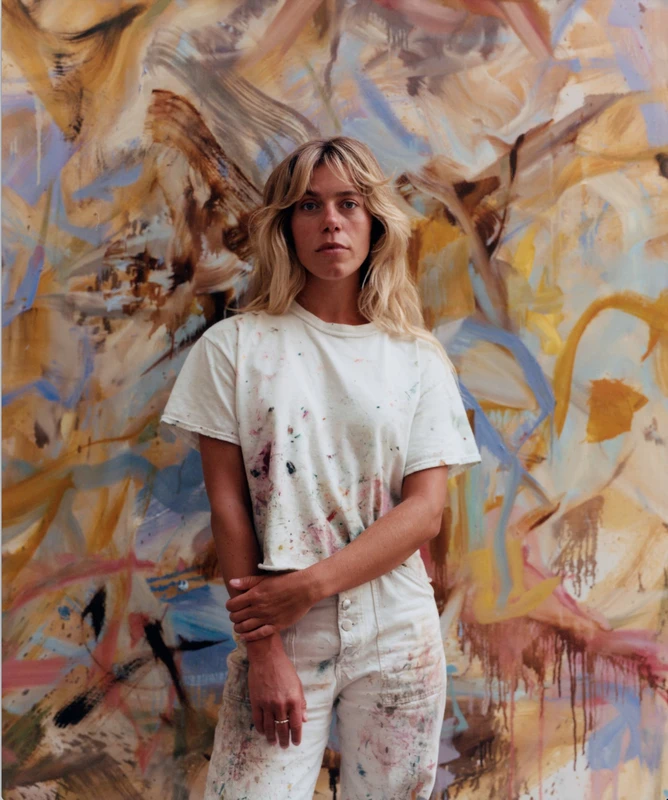
b. 1992, South Africa
Since completing her MA in Painting at The Royal College of Art and BA in History of Art at The Courtauld Institute of Art, Gina Kuschke (b.1992, Cape Town, South Africa) has developed a practice of abstract painting, giving form to a confluence of cultures, migratory patterns and personal memory.
Growing up between South Africa and London, Kuschke spent long periods by the sea and in the savanna, developing a heightened attentiveness to nature’s cues; how water, rocks, and the shifting contours of the varied and distinct landscapes that she moved between, reveal the visual effects of time. This, together with the inevitable adaptations that define the migrant experience of navigating contrasting contexts, cultivated her sensitivity to place. In her gestural approach to landscape, she maps the meeting of her external environment and inner geography, delivering a true translation of her lived experience.
Kuschke’s large-scale paintings are created through a sustained physical performance, making each composition intensely bodily. The works begin the moment she makes the painting’s ‘support’ – constructing the frame, stretching and grounding the canvas. ‘It is never a blank canvas’, she explains. Even before picking up a tool, Kuschke builds the work – materially and conceptually – a process which is integral to the final resolve.
Her approach to landscape is rooted in perception; as well as sight, she is tuned into sound. The early evolution of Kuschke’s practice is born out of a concurrent interrogation of painting and music. Sound – which resonates in her paintings through rhythmic marks and the tempo of their application – anchors her canvases, as she noted during her recent residency at Porthmeor Studios in St Ives, Cornwall: ‘the ocean is a metronome’. For Kuschke, the mark performs as an ever-active record of the temporal event of its creation; she sets the stage, interrupts, and then her action is lost to time. As she explains, ‘the paintings remain as eternally performing events. The painting is the snake, and I am its shedded skin’. Through marking and scoring, the immediacy and integrity of the line arises from this musical logic, in which Kuschke understands the interaction of ground and mark as analogous to harmony and melody.
Through a mode of high-planned spontaneity, she layers and erases paint in an ongoing exchange between artist and material. Marks become buried into the surface and shadows of structure hover between figuration and natural forms: ‘I treat the support as a witness to my body.’ The support is, in Kuschke’s terms, a ‘portal’ into a lineage of inherited language – artistic, intimate and collective. Through her paintings, she seeks to reveal the unseen threshold between the visible, physical world and the invisible, inner realm. Describing her practice of mark-making and drawing-in-space, Kuschke observes, ‘at some point in the process, a scene or event jumps out at me as something that is familiar, and the responsibility then, is to capture that’.
To inform her work, Kuschke gathers extensive, esoteric research, pulling from her academic background and her cross-cultural upbringing, to ready her hand for the abandon released in the act of painting. She engages with intentionally wide-ranging sources, including poems by Rainer Maria Rilke, memoirs by Philip Guston, and interviews between artists and writers such as Barbara Novak, Lee Krasner, Willem de Kooning and Harold Rosenberg. On her annual trips back to South Africa, which she sees as ‘pilgrimages’, Kuschke compiles a repository of materials – personal archives; folkloric stories found in histories such as Specimens of Bushman Folklore (1911); the writings of Antjie Krog, Breyten Breytenbach and James Matthews, as well as her own watercolours and journals. The paintings serve as conduits, providing a visual language through which to trace and contend with the temporal and material, the absent and the present.